M365 Business vs Enterprise: Pick the Right Plan for Growth
M365 Business and Enterprise are compared here based on their capabilities, pricing, integrations, and enterprise fit — helping organizations choose the right solution for their specific requirements and existing technology stack.
Compare Microsoft 365 Business and Enterprise plans with a practical decision framework covering security, compliance, scale, and migration readiness.
ARC Team
· Updated April 15, 2026 · ARC Team

Organizations looking to strengthen this area can work with Microsoft 365 services.
Choosing between Microsoft 365 Business and Enterprise plans is not only a licensing decision. It affects security posture, governance maturity, device management, and long-term operating cost.
The right choice depends on where your organization is today and what capabilities you need in the next 12 to 24 months.
Why This Decision Is Strategic
A low-cost plan can become expensive if it creates compliance gaps, fragmented controls, or migration rework later. The goal is to select the plan that matches your current needs while supporting predictable growth.
Business Plans: Best Fit Scenarios
Business plans are strong for small to mid-sized organizations prioritizing simplicity, fast onboarding, and lower per-user costs.
Enterprise Plans: Best Fit Scenarios
Enterprise plans are stronger for organizations requiring advanced identity controls, deeper compliance, and scalable policy management.
Decision Framework
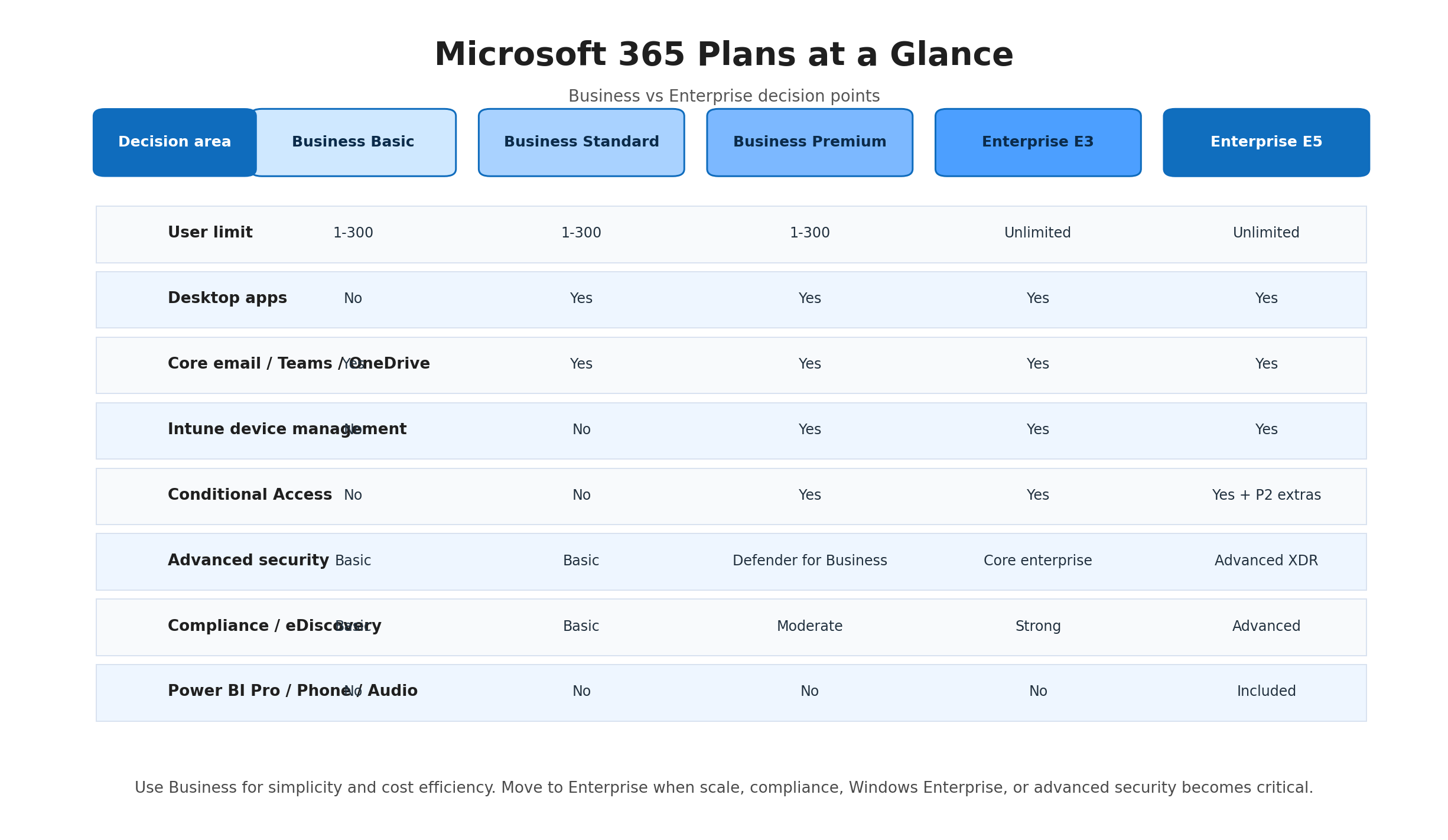
| Decision Area | Business Plans | Enterprise Plans |
|---|---|---|
| User scale | Small to mid-size organizations | Large or complex organizations |
| Security depth | Foundational controls | Advanced identity and protection stack |
| Compliance needs | Basic to moderate | Strong governance and regulatory readiness |
| IT control model | Simpler management | Centralized, layered governance |
Step 1: Assess Current State
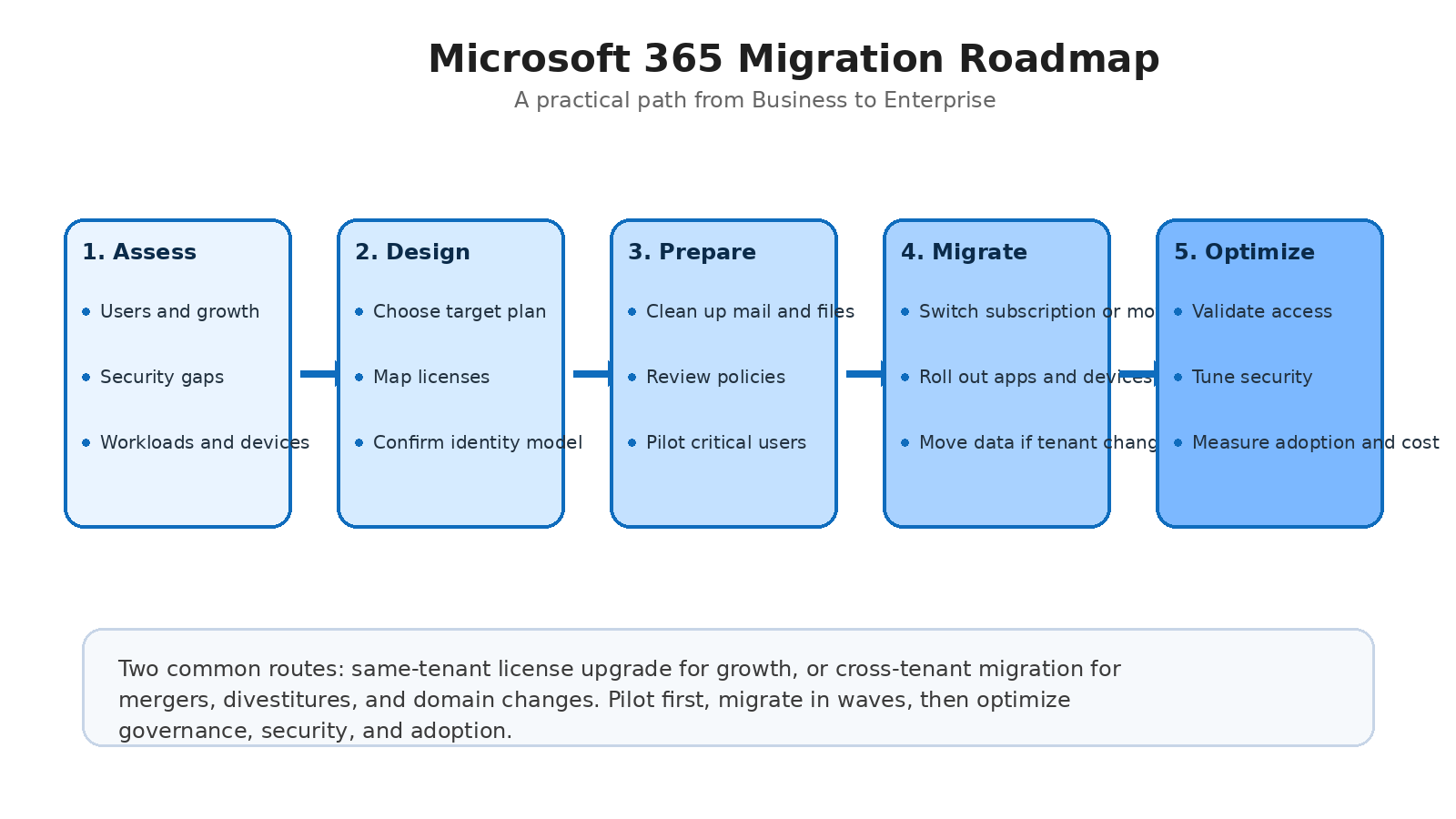
Evaluate current user count, device mix, workload dependency, and security gaps.
Step 2: Map Future Requirements
Project growth, regulatory obligations, and operational complexity for the next 1 to 2 years.
Step 3: Choose a Migration Path
Select same-tenant uplift or staged transition with clear checkpoints for identity, endpoint, and compliance readiness.
Key Business Benefits of a Right Plan Choice
- Better Cost Predictability: Licensing aligns with real usage and growth.
- Stronger Security Posture: Controls match risk profile and obligations.
- Improved IT Efficiency: Admin model scales with organizational complexity.
- Reduced Rework: Fewer mid-cycle disruptions from misaligned plan design.
Common Mistakes to Avoid
- Choosing solely by monthly license price
- Ignoring security and compliance requirements
- Delaying identity architecture decisions
- Migrating all users at once without pilot validation
Frequently Asked Questions
When should a company move from Business to Enterprise plans?
Typically when security, compliance, or management complexity exceeds what Business plans can support efficiently.
Is Enterprise always more expensive overall?
Not necessarily. Enterprise can reduce downstream risk and operational overhead in larger or more regulated environments.
Can we migrate in phases?
Yes. A phased strategy is usually safer and easier to govern than an all-at-once approach.
What should be validated before switching plans?
Identity model, policy architecture, endpoint readiness, licensing mapping, and adoption support should be validated first.
Conclusion
Microsoft 365 plan selection should be treated as an operating model decision, not just a license comparison. The right plan improves security, governance, and scalability while keeping delivery practical.
If your organization is evaluating Business vs Enterprise, ARC can help with strategy, migration planning, and optimization.
Frequently Asked Questions
When should a company move from Business to Enterprise plans?
Typically when security, compliance, or management complexity exceeds what Business plans can support efficiently.
Is Enterprise always more expensive overall?
Not necessarily. Enterprise can reduce downstream risk and operational overhead in larger or more regulated environments.
Can we migrate in phases?
Yes. A phased strategy is usually safer and easier to govern than an all-at-once approach.
What should be validated before switching plans?
Identity model, policy architecture, endpoint readiness, licensing mapping, and adoption support should be validated first.

ARC Team
ARC Team
AI-powered Microsoft Solutions Partner delivering enterprise solutions on Azure, SharePoint, and Microsoft 365.
LinkedIn Profile