Microsoft Fabric Capacity Costs: Control Them Now
Microsoft Fabric Capacity Costs is microsoft Fabric capacity pricing works, what drives spend across CUs, SKUs, storage, and reservations, and how to build governance that controls Fabric costs without slowing adoption.
Learn how Microsoft Fabric capacity pricing works, what drives spend across CUs, SKUs, storage, and reservations, and how to build governance that controls Fabric costs without slowing adoption.
Al Rafay Consulting
· Updated June 9, 2026 · ARC Team

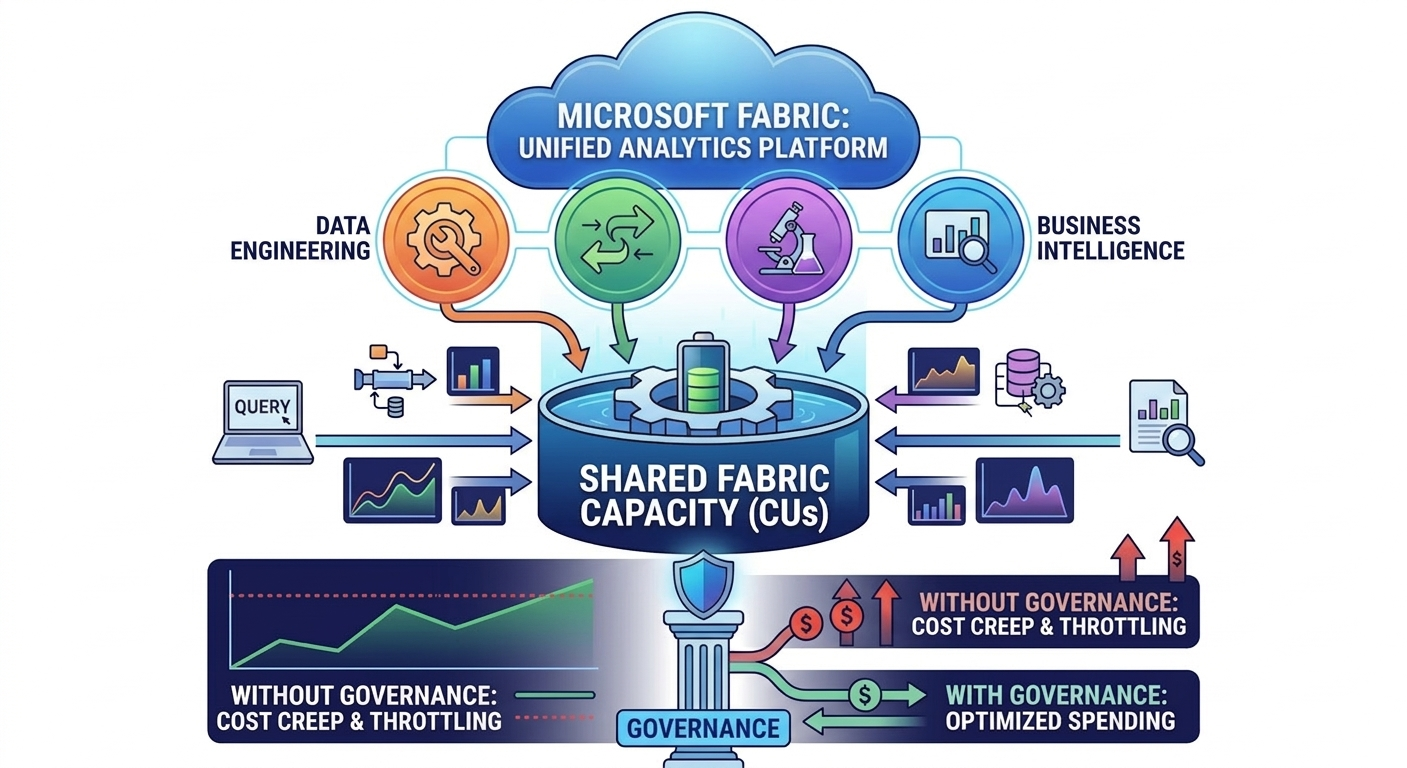
Microsoft Fabric can simplify your analytics platform, but it can also become expensive quickly if capacity is not governed. Shared compute, broad self-service adoption, and mixed workloads create a cost model that is powerful when managed well and frustrating when it is not.
Many organizations adopt Fabric for platform consolidation, only to discover that unclear workload ownership, poor SKU choices, weak monitoring, and unused capacity erase the expected savings.
The good news is that Fabric cost control is not mysterious. Once you understand how capacity units, SKU tiers, storage, reservation commitments, and governance fit together, you can build a model that scales without uncontrolled spend.
What Actually Drives Fabric Capacity Cost
Fabric cost is not just about how much data you store. It is primarily shaped by how compute is consumed across shared workloads.
The biggest drivers are:
- Capacity SKU size and the amount of compute available
- Mixed workload demand across BI, engineering, warehouse, and background jobs
- Whether usage is steady enough for reserved pricing
- OneLake storage footprint and lifecycle management
- Poorly optimized refreshes, pipelines, and ad hoc workloads
This is why Fabric cost governance has to be both technical and operational.
How Fabric Pricing Works in Practice
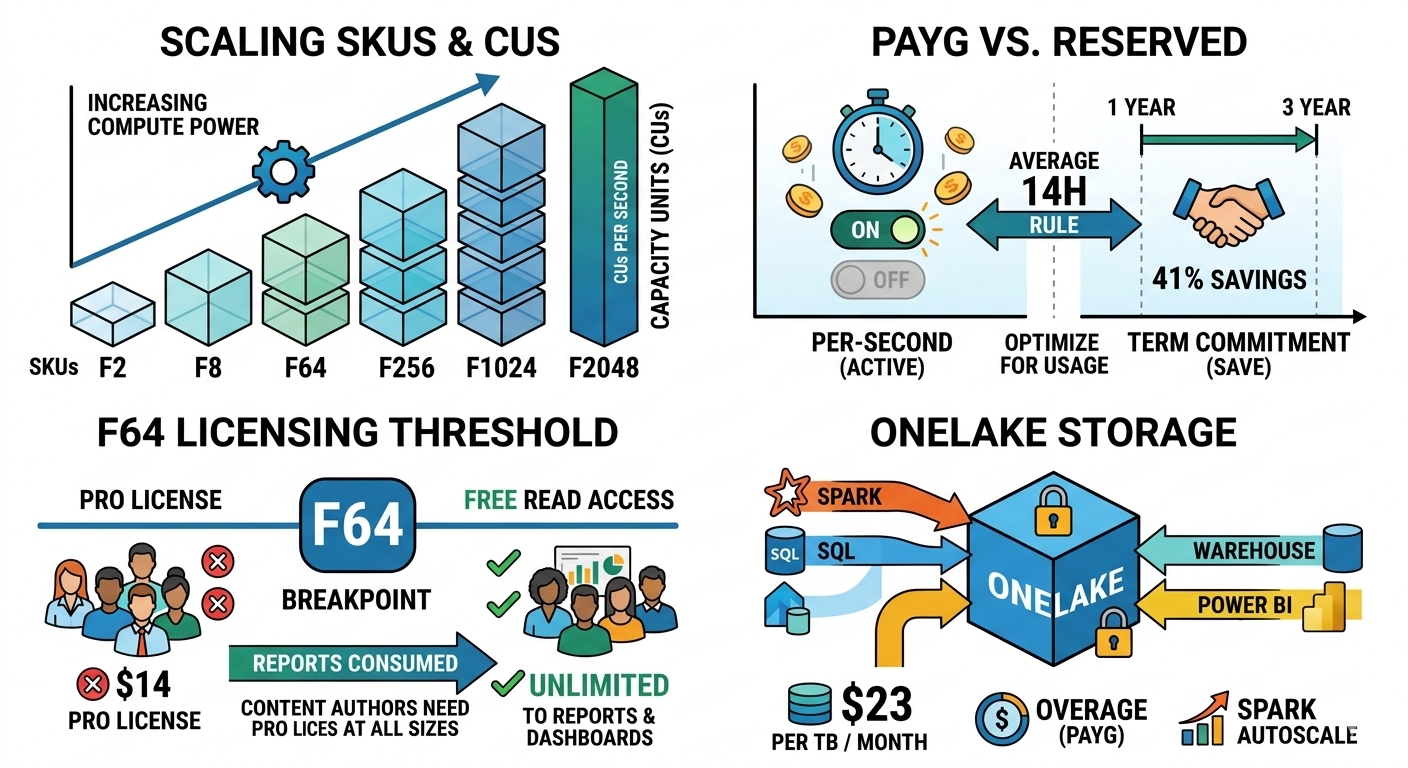
Fabric capacity pricing is centered on SKUs and compute availability. Higher SKUs provide more compute power, but that does not automatically mean better value. The right tier depends on sustained workload demand, licensing goals, and how much variability exists across the day.
SKUs, CUs, and the F64 Breakpoint
The source material highlights the SKU ladder from smaller F-series options up to large enterprise tiers. It also calls out the importance of the F64 threshold, where reader licensing behavior becomes materially different for broad BI consumption scenarios.
PAYG vs. Reserved Pricing
Reserved pricing is most attractive when capacity is used consistently. The underlying guidance indicates that sustained daily usage can justify annual commitments, while spiky or uncertain demand is often better left on pay-as-you-go until patterns stabilize.
OneLake Storage Still Matters
Even though compute gets most of the attention, OneLake storage costs, retention practices, and archival discipline still affect the total Fabric operating model.
A Practical Fabric Cost Control Framework
The fastest way to reduce spend is to treat Fabric like a governed platform, not a collection of independent workloads.
| Phase | Focus | Outcome |
|---|---|---|
| Phase 1: Establish visibility | Measure capacity usage, workload patterns, and storage growth | Clear cost baseline |
| Phase 2: Add guardrails | Apply budgets, ownership, quotas, and workspace governance | Fewer avoidable spikes |
| Phase 3: Optimize workloads | Tune refreshes, background jobs, and engineering patterns | Lower CU consumption |
| Phase 4: Align pricing to demand | Reassess PAYG, reservation, and SKU choices | Better long-term unit economics |
Phase 1: Establish Visibility
Start with capacity metrics, workspace usage, storage growth, refresh behavior, and which teams consume the most compute. Without a baseline, cost discussions stay subjective.
Phase 2: Add Guardrails
Define workspace ownership, budget accountability, alerting, tagging, and change approval for high-impact workloads. Governance is what prevents “temporary” experimentation from becoming permanent cost drift.
Phase 3: Optimize Workloads
Look for expensive refresh patterns, poorly partitioned models, oversized engineering jobs, and background workloads running more often than necessary. Many Fabric savings come from operating discipline rather than SKU changes.
Phase 4: Align Pricing to Demand
Once usage patterns are stable, revisit reserved pricing, SKU sizing, and licensing breakpoints. This is where many organizations finally realize the savings they expected at the start.
Governance Is the Difference Between Savings and Cost Creep
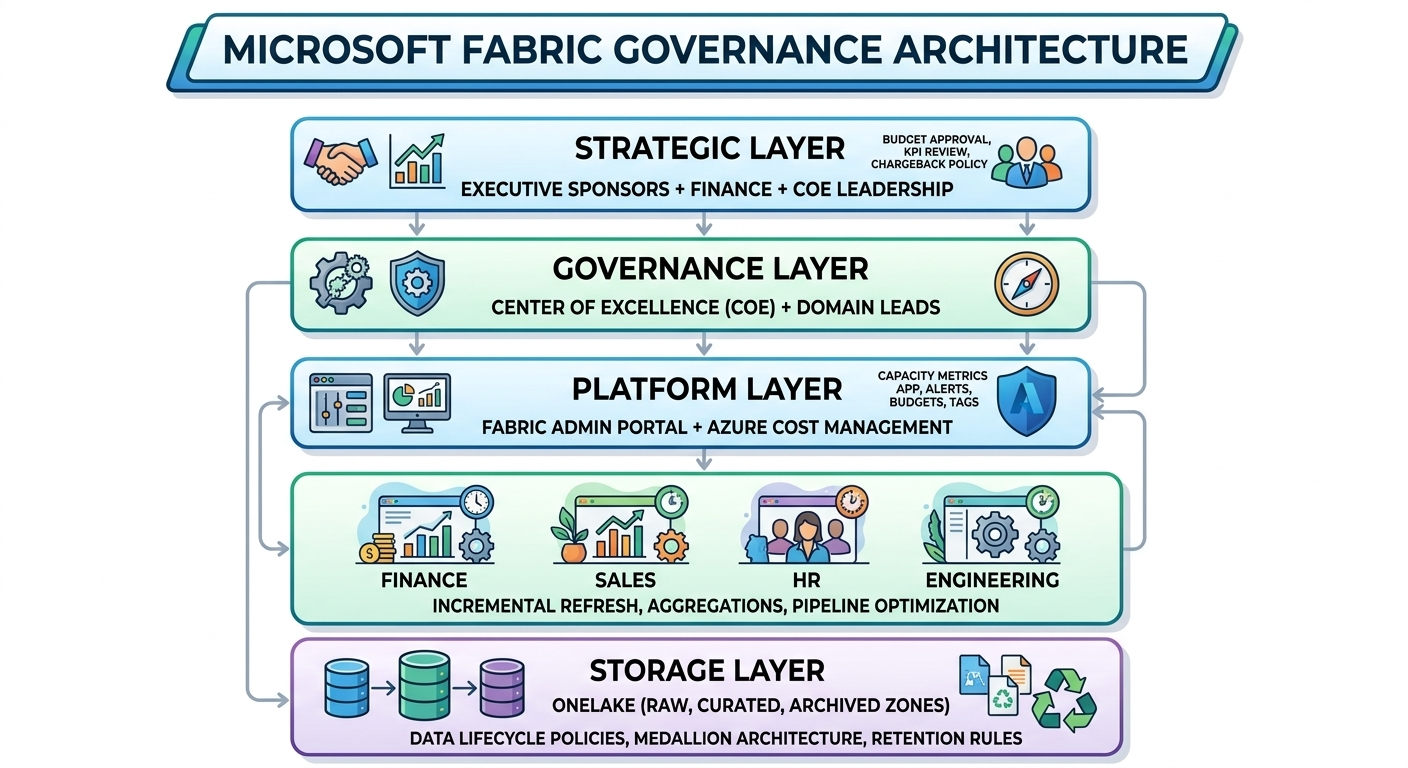
The source material is explicit here: without governance, Fabric can drift into throttling, surprise spend, and uneven value realization. The answer is a platform operating model that connects finance, the center of excellence, admins, and domain teams.
That model usually includes:
- Executive sponsorship and financial oversight
- A governance layer with platform and domain ownership
- Capacity metrics, alerts, and budgeting in the admin layer
- Workspace standards for departments and product teams
- Storage lifecycle policies across raw, curated, and archived data
Common Cost Problems Fabric Teams Run Into
- Buying more capacity before understanding the workload shape
- Keeping dev, test, and production on the same operational model
- Ignoring background jobs and refresh frequency
- Letting self-service expansion happen without workspace ownership
- Missing the licensing implications of capacity thresholds like F64
- Treating OneLake retention as free because compute is the bigger line item
Business Value of Better Fabric Cost Governance
- Higher return on platform consolidation: Savings only show up when teams stop recreating old inefficiencies on the new platform.
- Less throttling and fewer surprises: Capacity issues become measurable and manageable.
- Better investment timing: Reserved pricing and SKU upgrades happen based on evidence.
- More credible scale-out: Leadership is more willing to expand Fabric adoption when the operating model is controlled.
- Stronger cross-team accountability: Cost becomes part of platform design, not just a finance report.
Frequently Asked Questions
What drives Microsoft Fabric capacity costs the most?
The biggest drivers are shared compute demand across workloads, SKU size, refresh and engineering patterns, workload scheduling, reservation fit, and storage growth. Cost spikes usually come from governance gaps as much as from raw demand.
When should an organization choose reserved Fabric pricing?
Reserved pricing becomes attractive when capacity usage is steady and predictable enough to justify a term commitment. If your workload is still evolving or highly variable, pay-as-you-go may be safer until patterns stabilize.
Why does the F64 threshold matter in Fabric?
Because Fabric licensing behavior for report consumption changes materially at that point, which can affect the economics of broad BI distribution. The right choice depends on both compute needs and your reader population model.
How can teams reduce Fabric cost without hurting performance?
Start with visibility, then optimize expensive refreshes, background jobs, workspace design, and storage lifecycle. Teams often unlock meaningful savings before changing SKU levels when they govern the platform more deliberately.
Conclusion
Microsoft Fabric cost control is ultimately a governance problem as much as a pricing problem. The platform can deliver real value and real savings, but only when compute usage, workspace growth, licensing thresholds, and storage patterns are managed intentionally.
If your organization is scaling Fabric and needs to regain cost control, ARC can help with capacity analysis, governance design, workload optimization, and pricing alignment.
Frequently Asked Questions
What is Microsoft Fabric?
How is Fabric different from Azure Synapse?
What is OneLake in Microsoft Fabric?
How does Fabric pricing work?
Can I use Fabric with existing Power BI reports?

Al Rafay Consulting
ARC Team
AI-powered Microsoft Solutions Partner delivering enterprise solutions on Azure, SharePoint, and Microsoft 365.
LinkedIn Profile