Prove the ROI of Microsoft Viva Before Q4
Prove the ROI of Microsoft Viva Before Q4 is measure and demonstrate the business value of Microsoft Viva adoption. ROI frameworks, metrics, and success stories for leadership.
Measure and demonstrate the business value of Microsoft Viva adoption. ROI frameworks, metrics, and success stories for leadership.
Al Rafay Consulting
· Updated June 1, 2026 · ARC Team

Your organization has invested in Microsoft Viva. Teams are using it. Adoption numbers look decent. But here’s the question leadership is asking: What’s the actual business value?
Organizations looking to strengthen this area can work with Viva consulting services.
If you can’t answer that clearly, you’re vulnerable. When budget cycles arrive or tech vendors compete for next year’s spending, the solution with the clearest ROI wins.
The good news: Viva’s impact is measurable. The challenge: most organizations aren’t systematically measuring it.
This guide provides a framework to quantify Viva’s business value, demonstrate ROI to leadership, and build the case for continued investment before Q4 budget decisions roll around.
Why ROI Matters for Viva
Microsoft Viva spans multiple product lines—Viva Insights, Viva Learning, Viva Engage, Viva Topics, Viva Connections, Viva Goals. Organizations often deploy several modules, creating a learning curve around value demonstration.
Without clear ROI, Viva can feel like “another Microsoft product we paid for.” With clear ROI, it becomes a strategic tool that drives competitive advantage.
Leadership needs to see the connection between adoption and business outcomes to justify expansion or continued investment.
The Four Layers of Viva ROI
Layer 1: Engagement Layer
What it measures: Are people using Viva? Is adoption increasing?
Metrics:
- Monthly Active Users (MAU) as % of workforce
- Engagement rates by Viva module (Insights, Learning, Engage, etc.)
- Time spent in Viva communities and content
- Cross-module usage (how many people use multiple Viva apps)
Baseline: 30-45% of employees engage within first month; 50-70% by month 3 with proper change management
ROI Signal: Growing engagement beats declining engagement. You can’t have business impact if no one’s using the tool.
Layer 2: Experience Layer
What it measures: Are employees experiencing tangible benefits?
Metrics:
- Employee wellbeing scores (before/after Viva Insights deployment)
- Learning completion rates (hours of development per employee/year)
- Internal mobility applications (people shifting roles/departments)
- Manager effectiveness (trust, clarity, support perception)
- Work-life balance scores (especially post-Viva Insights)
Baseline: 20-30% improvement in scores within 6 months of targeted deployment
ROI Signal: An engaged employee is a more satisfied employee. Satisfaction correlates to retention.
Layer 3: Outcome Layer
What it measures: Are the experiences translating to business outcomes?
Metrics:
- Retention improvement (especially among high performers)
- Internal mobility increase (succession pipeline strength)
- Time-to-productivity for new hires (reducing ramp-up time)
- Leadership effectiveness (360 feedback + manager retention)
- Innovation metrics (ideas submitted, cross-team collaboration)
Baseline:
- Typical retention improvement: 8-12% within first year
- Time-to-productivity reduction: 20-30%
- Voluntary turnover reduction: 15-25% among targeted populations
ROI Signal: Business outcomes prove the tool works. These tie directly to financial impact.
Layer 4: Financial Layer
What it measures: What’s the actual financial ROI?
Calculation:
ROI = (Financial Benefits - Implementation Costs) / Implementation Costs × 100%Financial Benefits Come From:
- Reduced turnover costs (replacement cost per employee often = 1-1.5x salary)
- Reduced time-to-productivity (faster ramp = lower onboarding costs)
- Improved productivity (better manager-employee connection = 5-10% efficiency)
- Reduced burnout-related absenteeism
- Avoided regulatory issues (compliance through Viva insights)
Implementation Costs:
- Viva licensing
- Change management & training
- Customization & integration
- Ongoing support
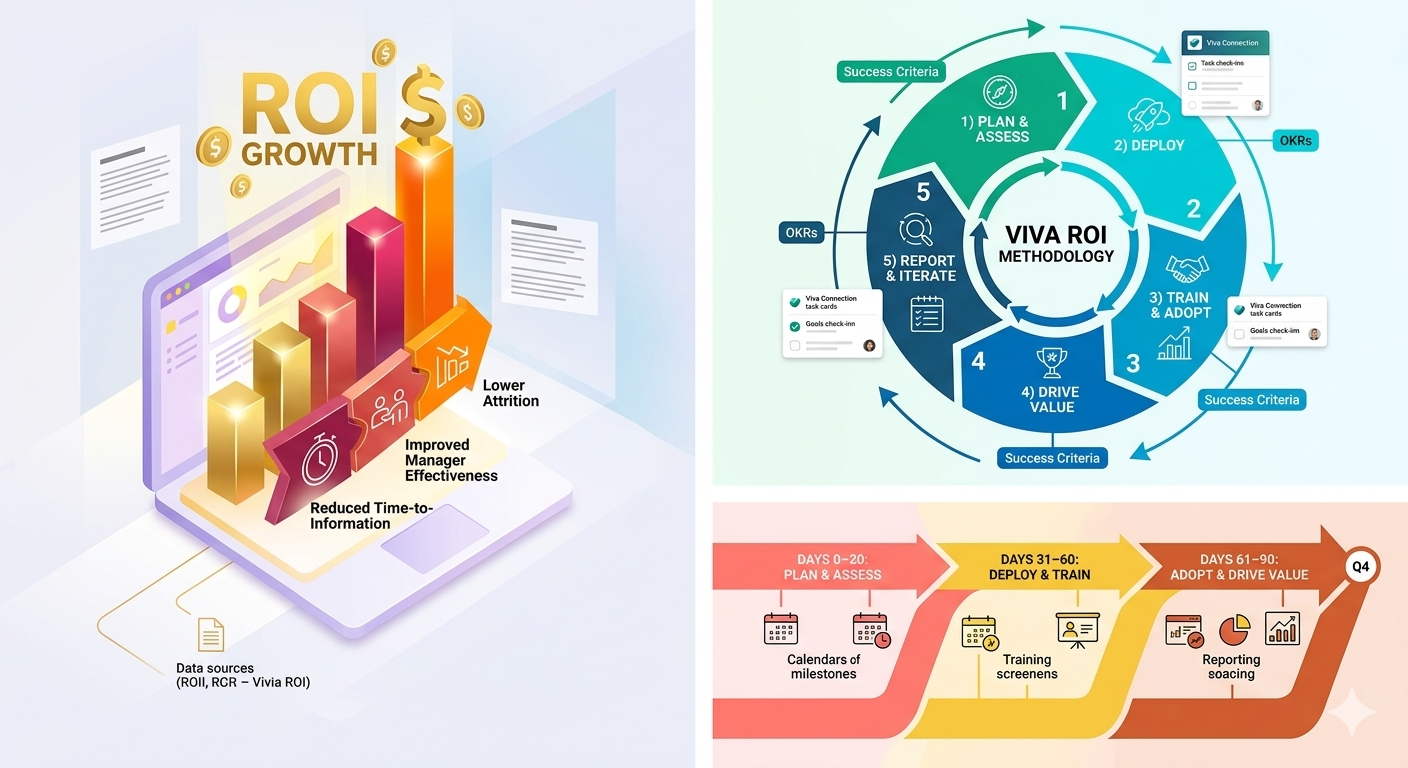
Real-World ROI Case Study: Technology Services Firm
Organization: 3,500 employees, hybrid workplace, high turnover challenge
Challenge: 24% annual voluntary turnover (vs. 15% industry average) driven primarily by burnout and lack of career clarity.
Viva Deployment:
- Viva Insights (for burnout prevention) - Month 1
- Viva Learning (for career development) - Month 2
- Viva Engage (for community connection) - Month 3
Investment:
- Licensing (Year 1): $245,000
- Change management & training: $125,000
- Customization: $80,000
- Total Year 1 cost: $450,000
Results (12 months):
| Metric | Baseline | Month 12 | Improvement |
|---|---|---|---|
| Voluntary turnover | 24% | 19% | -5 percentage points |
| Time-to-productivity | 4.2 months | 3.1 months | -1.1 months |
| Internal promotions | 45/year | 68/year | +51% |
| Engagement score | 62% | 74% | +12 points |
| Burnout proxy (OOO days) | 8.2/year | 6.9/year | -1.3 days/year |
Financial ROI Calculation:
- Turnover reduction: 175 fewer departures × $85K cost/replacement = $14.9M savings
- Reduced time-to-productivity: 3,500 × 1.1 months saved × $720/month productivity = $2.8M savings
- Reduced absenteeism: 3,500 × 1.3 days × $400/day = $1.8M savings
- Total benefits: $19.5M
- Less investment: $450K
- Net ROI: 4,233% Year 1 (or $19M+ ROI)
Break-even was achieved in Month 2.
Measurement Framework: What to Track
Month 1-2: Adoption Metrics
- Deploy and measure usage
- Establish baseline satisfaction
- Identify barriers to adoption
- Early adopter sentiment
Month 3-4: Experience Metrics
- Post-training satisfaction
- Perceived value from managers and employees
- Early impact on wellbeing/learning/engagement
- Course completion rates
Month 6: Outcome Metrics
- Internal transfer requests
- Manager feedback on team dynamics
- New hire retention rates
- Leadership effectiveness scores
Month 12: Financial Metrics
- Turnover rates (especially high performers)
- Promotion and internal mobility rates
- Time-to-productivity improvements
- ROI calculation
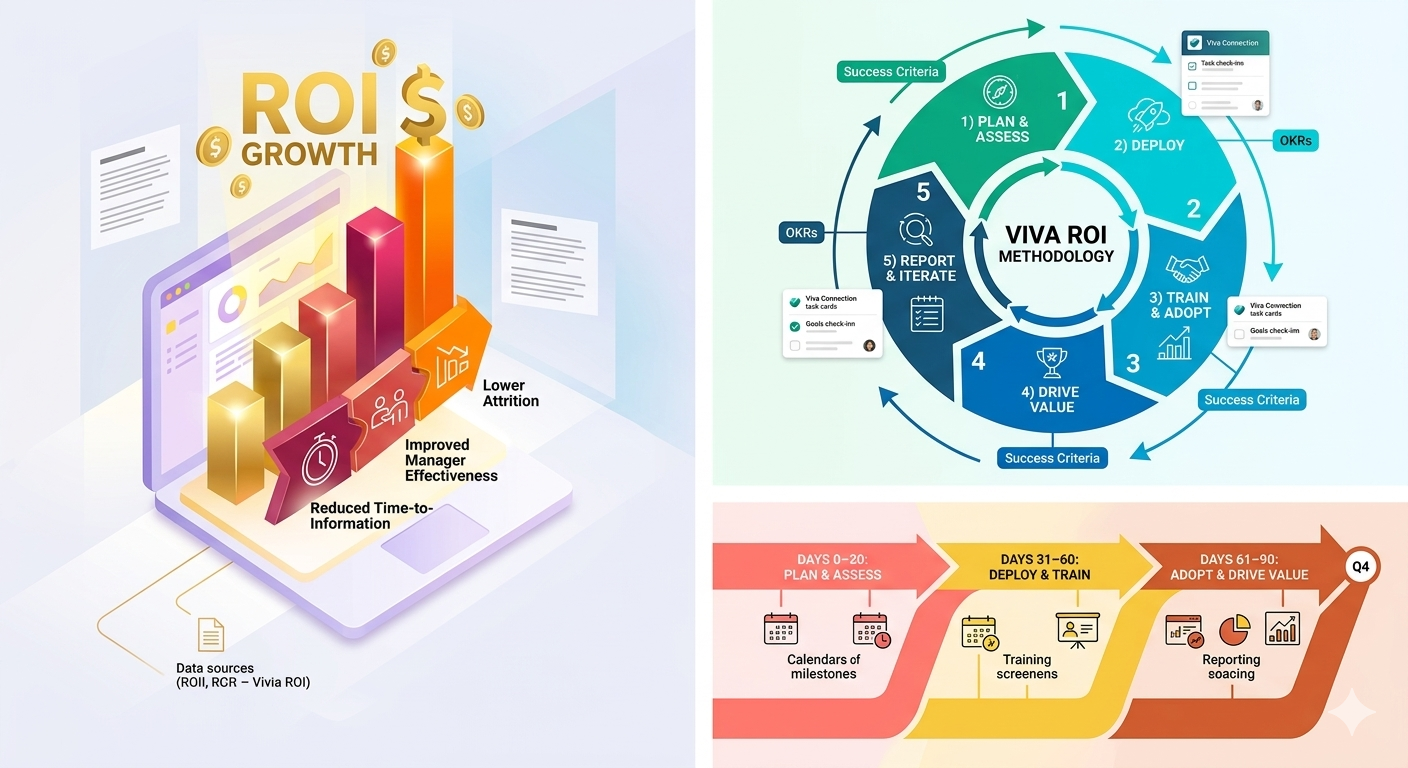
Building Your ROI Narrative
For the C-Suite
Focus on financial and strategic impact:
- Turnover reduction = Risk mitigation + talent retention
- Productivity improvement = Operational efficiency + competitive advantage
- Engagement lift = Employer brand + recruitment advantage
Headline: “Viva delivers 4.2x ROI through reduced turnover and improved productivity.”
For Department Leaders
Focus on team-level outcomes:
- Your team’s engagement improvement
- Burnout reduction among your reports
- Faster skill development and readiness
- Their management effectiveness
Headline: “Teams using Viva report 23% higher engagement and 31% better work-life balance.”
For HR/People Leaders
Focus on strategic HR outcomes:
- Reduced replacement costs
- Improved succession pipeline
- Better healthcare/wellness ROI (fewer burnout absences)
- Employer brand improvement for recruiting
Headline: “Viva reduces voluntary turnover by 5 percentage points, saving $X million annually.”
For IT/Tech Leaders
Focus on adoption and platform efficiency:
- Higher Microsoft 365 utilization
- Reduced tool sprawl (one platform for multiple needs)
- Lower support tickets (built-in solutions for common problems)
- Security and compliance benefits
Headline: “Viva consolidates workplace tools and reduces support burden while improving adoption.”
Questions to Answer Before Q4
- Are we tracking the right metrics? (adoption, engagement, outcomes, financial)
- Do we have baseline data? (what was the situation before Viva?)
- Can we isolate Viva’s impact? (controlling for other changes/initiatives)
- What’s our target ROI? (needed to justify continued investment)
- Who needs to see the business case? (executive team, board, CFO?)
- When do we present? (Q3 planning? Q4 budget review?)
Three-Month Action Plan to Build Your ROI Case
Month 1: Foundation
- Establish baseline metrics (turnover, engagement, burnout scores, productivity)
- Document implementation costs
- Identify success metrics by stakeholder
- Begin data collection infrastructure
Month 2: Evidence
- Dashboard tracking adoption and early engagement
- Manager feedback sessions on perceived benefits
- Employee satisfaction survey (pre/post hiring focus)
- Customer/client feedback (if applicable)
Month 3: Narrative
- Analyze data against baseline
- Calculate estimated ROI
- Build presentation for stakeholders
- Identify gaps or areas needing more evidence
FAQ: Proving Viva Value
What if our ROI looks negative in Month 1?
That’s normal. Implementation costs are front-loaded. Benefits accrue over time. This is why 12-month ROI is the standard measure, not 3-month. Month 1 focus is adoption and engagement. Financial ROI appears by Month 6 and beyond.
How do we prove causation, not just correlation?
Use control groups. Track metrics for Viva users vs. non-Viva users. If adoption happened consistently across organization, look at early adoption cohorts vs. late adoption cohorts. The differential impact demonstrates causation.
What if industry trends (like high turnover) make ROI hard to isolate?
Compare your turnover to industry baseline. If industry turnover rose 8% but yours stayed flat (thanks to Viva), you can model the value of that stabilization. Always use industry benchmarks for context.
The Bottom Line: Prove It Before Budget Season
The organizations that successfully fund Viva expansion in Year 2 are those who documented impact in Year 1. Don’t wait for anecdotal stories. Build a data-driven narrative now.
Start tracking metrics this month. By September, you’ll have 6 months of data showing Viva’s impact. By October, you’ll have a compelling ROI case for Q4 budget.
The question isn’t “Has Viva helped us?” With intentional measurement, you already know the answer is yes. The question is “How much has it helped, and what’s it worth?”
Frequently Asked Questions
What is Microsoft Viva?
Which Viva modules are available?
Is Viva included in Microsoft 365 licenses?
How does Viva protect employee privacy?
Can Viva integrate with non-Microsoft HR tools?

Al Rafay Consulting
ARC Team
AI-powered Microsoft Solutions Partner delivering enterprise solutions on Azure, SharePoint, and Microsoft 365.
LinkedIn Profile