AI Agents Explained: What Enterprises Must Know Now
AI agents are autonomous software systems that can reason through multi-step tasks, use enterprise tools, and complete workflows with minimal human intervention — going far beyond simple chatbots to deliver real business automation.
A practical enterprise guide to AI agents, including architecture, governance, adoption roadmap, and measurable business outcomes.
ARC Team
· Updated April 6, 2026 · ARC Team

AI agents are rapidly becoming a core part of enterprise digital operations. Unlike simple chat tools, agents can reason through tasks, use enterprise systems, and complete multi-step workflows with clear objectives.
Organizations looking to strengthen this area can work with AI agent development services.
That shift creates major opportunity, but also introduces governance, architecture, and operating model requirements that many organizations underestimate.
What AI Agents Actually Are
An AI agent is a goal-oriented system that can understand context, choose actions, and interact with tools or data sources to complete work. In enterprise settings, this means agents can support real workflows across service, operations, and internal productivity.
Why Enterprises Are Investing in AI Agents
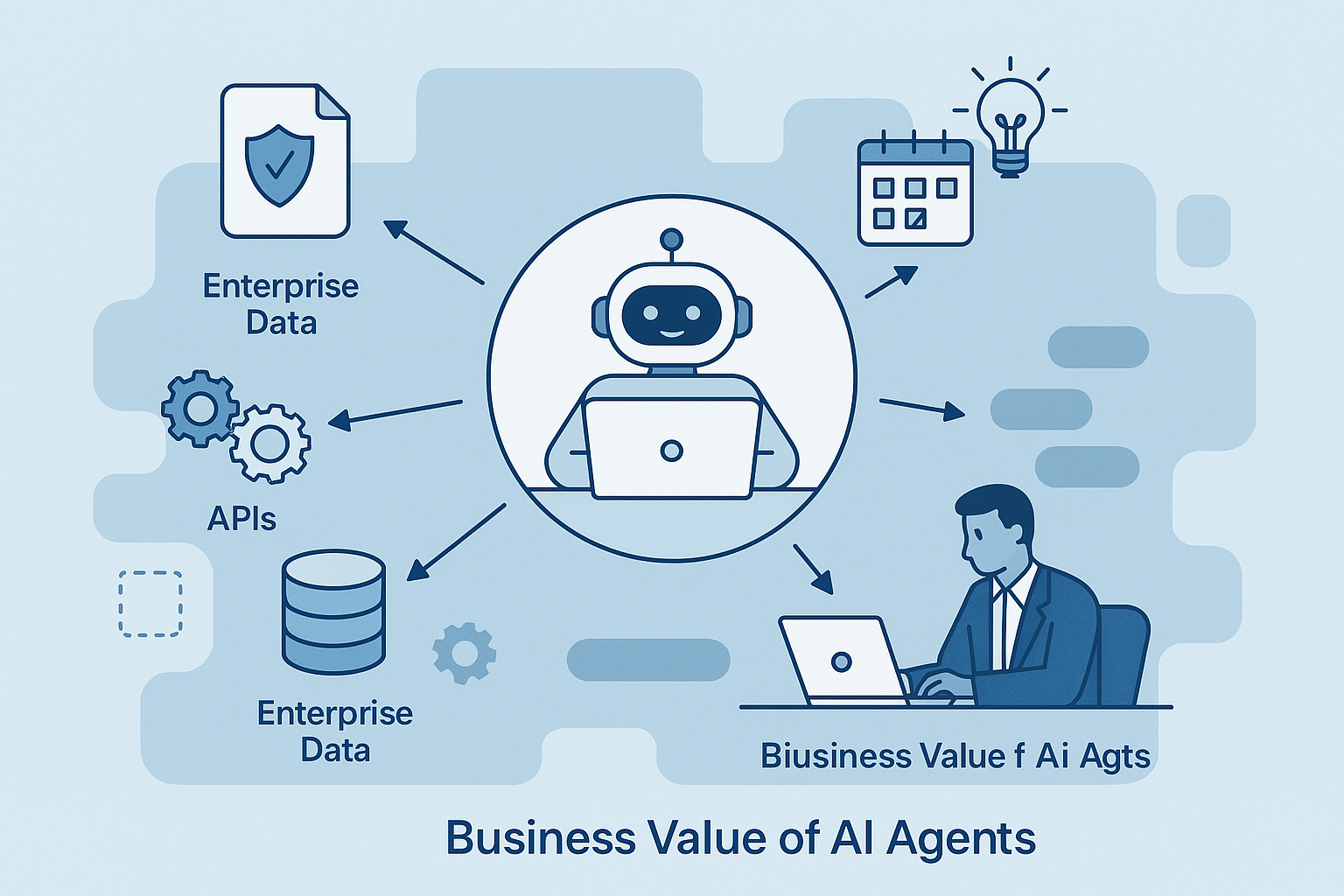
Workflow Acceleration
Agents can reduce cycle time by handling repetitive, structured, and context-heavy operational tasks.
Better Decision Support
Agents can summarize signals from multiple sources, improving speed and quality of business decisions.
Scalable Service Delivery
With governance in place, agents help teams support more requests without linear staffing growth.
Enterprise Adoption Framework
| Phase | Focus | Outcome |
|---|---|---|
| Phase 1 | Readiness and use-case selection | Prioritized adoption roadmap |
| Phase 2 | Pilot with governance controls | Validated delivery model |
| Phase 3 | Scale and optimize | Sustainable enterprise capability |
Phase 1: Define Scope and Controls
Choose workflows with clear business value and low ambiguity. Define data boundaries, access controls, and escalation paths before deployment.
Phase 2: Run a Controlled Pilot
Deploy agents for one or two focused scenarios. Measure quality, containment, and business impact while validating governance assumptions.
Phase 3: Scale Responsibly
Expand to additional domains with repeatable architecture patterns and shared operational standards.
Key Benefits for Enterprises
- Higher Operational Efficiency: Routine workflows are completed faster.
- Improved Consistency: Standardized agent behavior reduces process variance.
- Better Knowledge Utilization: Agents make institutional knowledge easier to access and apply.
- Scalable Automation: Organizations expand capability without proportional staffing increases.
Critical Considerations Before Rollout
- Define ownership across IT, security, and business teams
- Establish policy controls for data and action boundaries
- Implement observability for audit and performance tracking
- Design human handoff paths for high-risk scenarios
Frequently Asked Questions
How are AI agents different from chatbots?
Chatbots usually respond to prompts, while AI agents can execute multi-step actions and operate against defined goals.
Are AI agents safe for enterprise deployment?
Yes, when implemented with role-based access, policy controls, audit logs, and clear human oversight.
What is the best first use case for AI agents?
Start with high-volume, rules-driven workflows where measurable efficiency gains are likely.
How should success be measured?
Track resolution quality, time saved, escalation rate, adoption trends, and business-cycle impact.
Conclusion
AI agents can deliver significant enterprise value when adoption is treated as a strategic capability program, not a feature rollout. Organizations that pair strong governance with practical implementation can scale outcomes predictably.
If your organization is exploring AI agents, ARC can help with strategy, implementation, governance, and optimization.
Frequently Asked Questions
How are AI agents different from chatbots?
Chatbots usually respond to prompts, while AI agents can execute multi-step actions and operate against defined goals.
Are AI agents safe for enterprise deployment?
Yes, when implemented with role-based access, policy controls, audit logs, and clear human oversight.
What is the best first use case for AI agents?
Start with high-volume, rules-driven workflows where measurable efficiency gains are likely.
How should success be measured?
Track resolution quality, time saved, escalation rate, adoption trends, and business-cycle impact.

ARC Team
ARC Team
AI-powered Microsoft Solutions Partner delivering enterprise solutions on Azure, SharePoint, and Microsoft 365.
LinkedIn Profile