GitHub Copilot + Microsoft Foundry: The Complete Developer Guide
GitHub Copilot + Microsoft Foundry is to combine GitHub Copilot and Microsoft Foundry to ship AI-powered software faster with strong governance, security, and enterprise-scale delivery controls.
Learn how to combine GitHub Copilot and Microsoft Foundry to ship AI-powered software faster with strong governance, security, and enterprise-scale delivery controls.
ARC Team
· Updated April 6, 2026 · ARC Team

AI-powered development is no longer about writing code faster. Enterprise teams now need to deliver faster while maintaining architecture standards, security controls, and auditability. That is exactly where GitHub Copilot and Microsoft Foundry create outsized value together.
Copilot accelerates day-to-day engineering execution. Foundry gives teams a governed platform to build, evaluate, and operationalize AI-driven applications and agents across enterprise environments. Used together, they reduce cycle time while preserving control.
Why This Combination Matters
Most teams already use one of these tools in isolation. The problem is that speed without governance leads to risk, and governance without speed leads to slow delivery. Copilot and Foundry close that gap.
What GitHub Copilot Delivers
GitHub Copilot helps developers move faster by reducing repetitive coding effort and improving implementation flow.
- Faster first-draft code and boilerplate generation
- Quicker test scaffolding and refactoring support
- Better momentum for junior and mid-level engineers
- Reduced context-switching during feature development
What Microsoft Foundry Delivers
Microsoft Foundry gives enterprises a structured path to move from AI experiments to governed production outcomes.
- Model and agent lifecycle governance
- Environment-level controls for evaluation and deployment
- Integration with enterprise identity and policy standards
- Better visibility into AI behavior and performance
Implementation Framework for Enterprise Teams
| Phase | Focus | Outcome |
|---|---|---|
| Phase 1 | Readiness and governance baseline | Clear rollout guardrails |
| Phase 2 | Developer workflow integration | Faster and safer delivery |
| Phase 3 | Scale and continuous optimization | Repeatable AI engineering model |
Phase 1: Define Standards Before Scale
Set policy boundaries first: approved usage patterns, data handling expectations, and review checkpoints for AI-generated outputs.
Phase 2: Integrate Into Real Workflows
Embed Copilot and Foundry practices into backlog execution, code review, testing, and release workflows rather than treating them as side experiments.
Phase 3: Measure and Improve
Track cycle-time impact, defect trends, and governance adherence. Use this data to tune prompts, templates, and approval paths.
Business Value You Can Expect
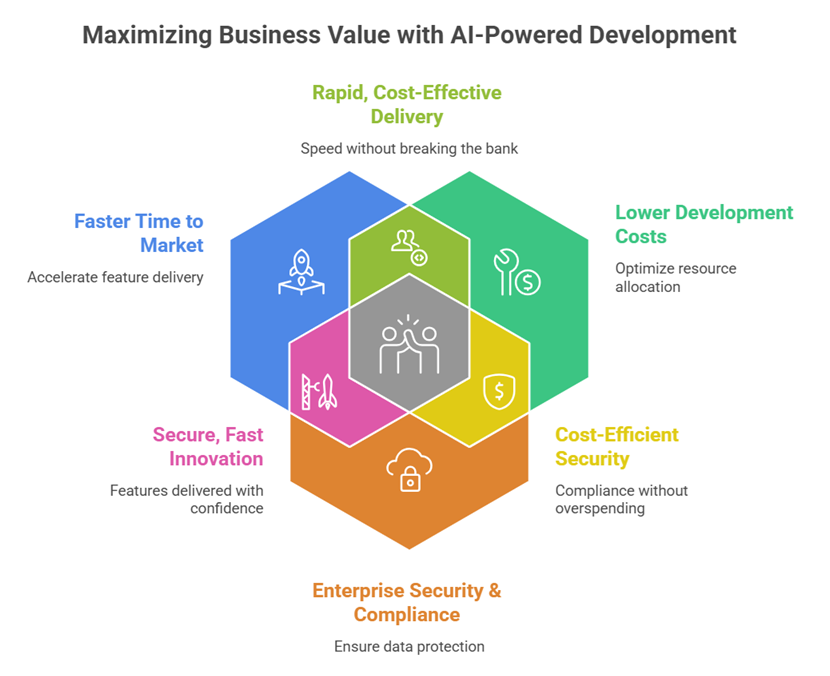
- Faster Time-to-Value: Teams ship features in shorter delivery cycles.
- Higher Engineering Leverage: Developers focus on design and business logic, not repetitive code.
- Better Governance: AI workflows stay aligned with policy and compliance requirements.
- Scalable Adoption: Standardized practices reduce rollout friction across teams.
Common Enterprise Pitfalls to Avoid
- Skipping governance design before broad enablement
- Treating Copilot output as production-ready without review
- Failing to define ownership for AI quality and risk
- Ignoring adoption metrics and process tuning
Frequently Asked Questions
Is GitHub Copilot enough for enterprise AI strategy?
Copilot is excellent for developer productivity, but it should be paired with governance, lifecycle controls, and platform strategy for enterprise-wide AI delivery.
Why combine Copilot with Microsoft Foundry?
Copilot improves execution speed, while Foundry strengthens governance and operationalization. Together they balance velocity and control.
How long does rollout typically take?
A focused pilot can start in weeks. Enterprise-wide adoption usually follows in phased waves based on team readiness and governance maturity.
What should be measured first?
Start with cycle time, code quality indicators, policy adherence, and rework rate to evaluate real business impact.
Conclusion
GitHub Copilot and Microsoft Foundry are strongest when implemented as a coordinated engineering system, not isolated tools. Enterprises that combine delivery speed with governance discipline can scale AI development with confidence.
If your organization is evaluating this path, ARC can help with strategy, implementation planning, governance design, and optimization.
Frequently Asked Questions
Is GitHub Copilot enough for enterprise AI strategy?
Why combine Copilot with Microsoft Foundry?
How long does rollout typically take?
What should be measured first?

ARC Team
ARC Team
AI-powered Microsoft Solutions Partner delivering enterprise solutions on Azure, SharePoint, and Microsoft 365.
LinkedIn Profile