Dedicated Development Team: Cost, Model and Microsoft Stack Fit
A dedicated development team is a vendor-employed pod working exclusively on your roadmap, integrated with your process and delivery cadence.
See dedicated development team costs, delivery models, and Microsoft-stack fit across Azure, .NET, Power Platform, and Dynamics 365.
Al Rafay Consulting
· Updated July 13, 2026 · ARC Team
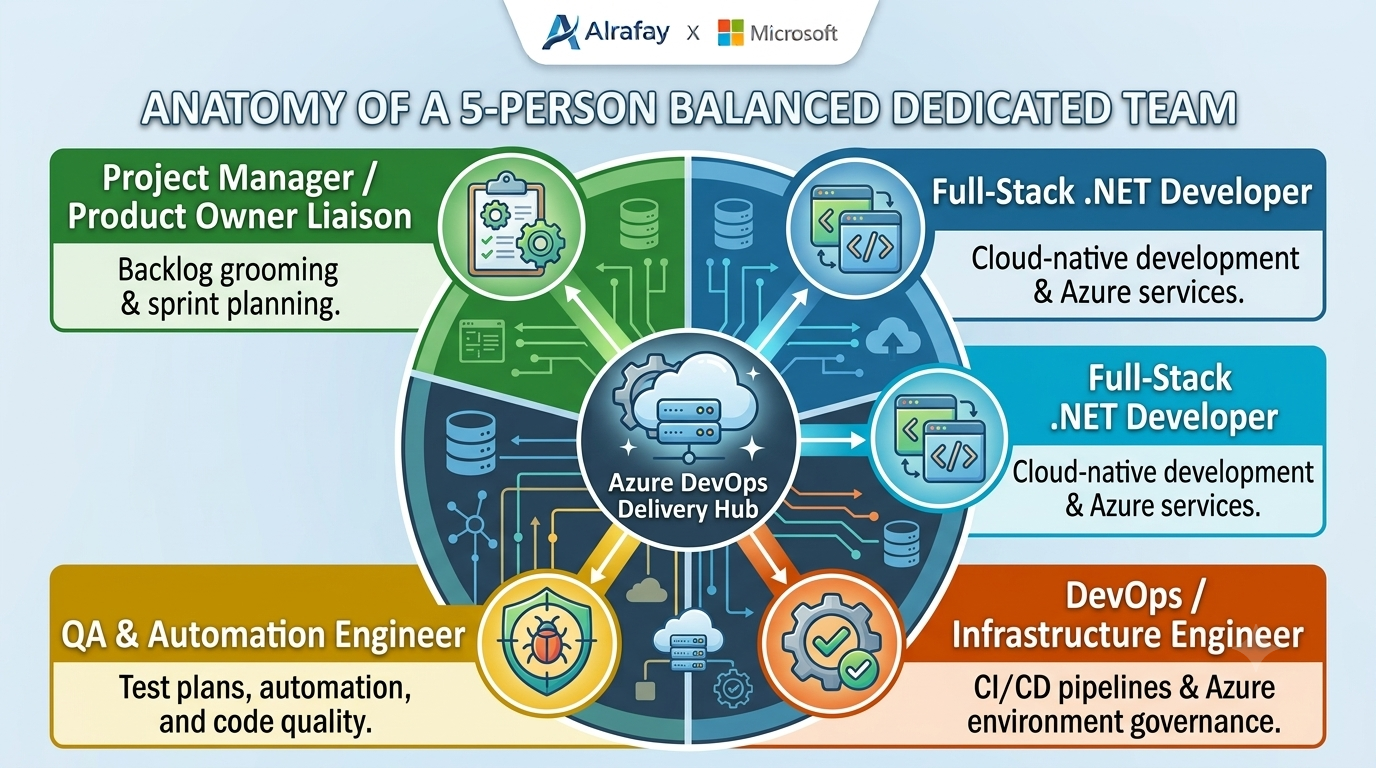
Your roadmap is moving faster than your hiring pipeline. Priorities are approved, budget is allocated, and delivery pressure keeps increasing, but key engineers are still months away. This is where a dedicated development team becomes a practical execution model, especially for organizations building on Azure, .NET, Power Platform, and Dynamics 365.
If your next decision is build-team structure, start by reviewing our Managed IT Services solutions to plan how development and long-term operations should work together.
Quick Answer: What Is a Dedicated Development Team?
A dedicated development team is a vendor-employed group of engineers, QA, and delivery roles working exclusively on your roadmap over time. It is not fixed-scope outsourcing. The team works in your sprint rhythm, attends your ceremonies, and ships against evolving priorities while the vendor handles recruiting, HR, and continuity.
Who Owns What
| Responsibility | Typical owner |
|---|---|
| Product direction and priorities | Client |
| Sprint planning and backlog grooming | Shared |
| Engineering execution | Dedicated team |
| Recruiting, payroll, HR | Vendor |
| Delivery reporting and metrics | Shared |
Best-Fit Signals
| Signal | Fit |
|---|---|
| Long-term roadmap and recurring releases | Strong fit |
| One-time fixed deliverable | Weak fit |
| Need Microsoft-specialized skills quickly | Strong fit |
| No internal product owner | Weak fit |
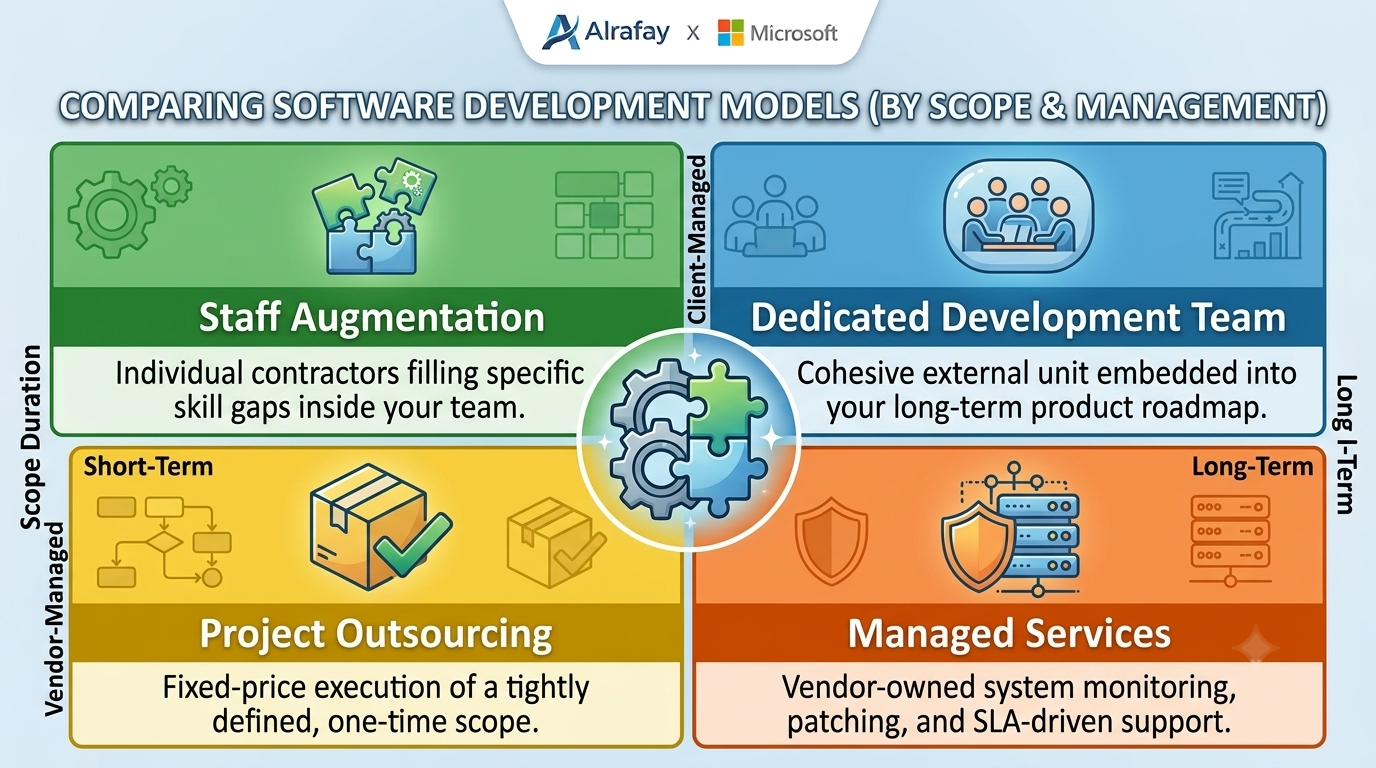
Dedicated Team vs Staff Augmentation vs Outsourcing vs Managed Services
| Model | What it is | Best for | Watch-out |
|---|---|---|---|
| Dedicated team | Stable vendor pod embedded in your process | Long-term roadmap delivery | Needs clear internal ownership |
| Staff augmentation | Individual specialists added to your team | Short-term capacity spikes | Lower continuity |
| Project outsourcing | Fixed scope and timeline handoff | Well-defined one-time builds | Lower flexibility for changes |
| Managed services | SLA-backed operations ownership | Ongoing support and uptime | Not feature-roadmap focused |
When your platform is moving from build to operate, managed IT services are often the better model for production support while development pods stay focused on roadmap outcomes.
When a Dedicated Development Team Is the Right Choice
1. Long-Term Product Roadmaps
If you are shipping continuously across quarters, team continuity compounds value. The same engineers retain architectural context, reduce ramp time, and improve release confidence.
2. Azure and .NET Modernization
Cloud modernization is not a one-sprint task. A dedicated pod helps sustain architecture, cost optimization, and migration sequencing across dependent systems.
3. Power Platform and Dynamics 365 Backlogs
Backlog-heavy ecosystems benefit from a team that understands your governance model and release constraints, rather than rotating short-term contributors.
4. Persistent Internal Capacity Gaps
When hiring cannot keep up, dedicated teams provide consistent execution without long in-house recruitment cycles.
When Not to Use This Model
- One-time, tightly scoped projects with stable requirements
- No internal product owner to prioritize backlog decisions
- Strictly on-site-only requirements where remote delivery cannot work
- Budget model that only supports milestone payments
What a Microsoft-Focused Dedicated Team Looks Like
A Microsoft-focused pod is structured around stack-specific execution and governance:
- .NET and Azure engineering aligned to reliability, security, and cost control
- Power Platform delivery with ALM discipline and environment strategy
- Dynamics 365 delivery aligned to Success by Design principles
- DevOps, QA automation, and security review integrated into release flow
Typical Team Compositions
| Team size | Typical composition |
|---|---|
| 3-person starter | Full-stack engineer, QA engineer, part-time architect |
| 5-person balanced pod | 2 engineers, QA, DevOps, PM/PO liaison |
| 7-person platform pod | 3 engineers, QA, DevOps, architect, PM |
Cost Benchmarks for Dedicated Teams
| Region | Estimated monthly range for 5-person pod |
|---|---|
| India | 16,600 USD to 27,200 USD |
| Vietnam | 19,600 USD to 28,000 USD |
| Latin America | 27,200 USD to 39,000 USD |
| Eastern Europe | 31,000 USD to 45,000 USD |
These are planning ranges, not quotes. Final costs vary by role mix, seniority, overlap expectations, and governance requirements.
Hidden Costs to Account For
- Ramp-up and onboarding periods
- Tooling and license gaps
- Time-zone overlap constraints
- Offboarding and knowledge-transfer effort
How to Choose the Right Delivery Partner
- Validate Microsoft credentials and actual specialization depth
- Interview the real engineers who will be assigned
- Run a paid trial sprint before long-term commitment
- Lock delivery cadence and reporting expectations
- Define IP ownership and security obligations in writing
- Agree on transition and documentation standards from day one
Common Risks and Practical Controls
| Risk | Why it happens | Control |
|---|---|---|
| Scope drift | Weak requirement boundaries | Baseline scope and formal change control |
| Quality inconsistency | Ad hoc standards | Shared coding standards and QA gates |
| Security gaps | Informal access model | Least-privilege access and documented controls |
| Low visibility | No shared boards and KPIs | Shared Azure DevOps reporting and demo cadence |
| Knowledge loss | No transition planning | Continuous documentation and handoff plan |
Best Practices
- Assign a decisive internal product owner
- Start with a trial sprint to validate team fit
- Keep governance explicit across architecture and release controls
- Ensure shared visibility into backlog, pipelines, and quality metrics
- Plan operations handoff early to avoid post-launch delivery drag
Conclusion
A dedicated development team is not just outsourced labor. Done correctly, it is a stable execution capability for long-term roadmap delivery. For Microsoft-centric environments, results improve when engineering and operations are designed together from the start.
To align your build model with long-term platform operations, review our Managed IT Services solutions and map the right handoff path for your roadmap.
Ready to Choose the Right Model?
Al Rafay Consulting helps organizations decide between dedicated teams, staff augmentation, and managed services using Microsoft-first delivery frameworks and measurable governance standards.
Frequently Asked Questions
What is a dedicated development team?
A dedicated development team is a vendor-employed group of engineers and delivery roles that works exclusively on one client's roadmap while operating inside the client's planning and sprint process.
How is a dedicated development team different from staff augmentation?
A dedicated team is a stable, cohesive pod managed for long-term roadmap delivery, while staff augmentation adds individual resources to fill short-term capacity or skill gaps.
How much does a dedicated development team cost?
For a balanced five-person pod, planning ranges commonly run from about 16,600 USD to 45,000 USD per month, depending on region, seniority, and specialization requirements.
When should I hire a dedicated development team?
This model fits best when you have a long-term evolving roadmap, sustained capacity needs, and ongoing Microsoft platform work rather than a one-time fixed-scope project.
What is a Microsoft-focused dedicated development team?
It is a pod structured around Azure, .NET, Power Platform, Dynamics 365, and Microsoft DevOps practices, aligned to frameworks like Azure Well-Architected and Success by Design.
When should dedicated development shift into managed IT services?
When the platform reaches stable production operations and needs SLA-backed monitoring, support, and maintenance, managed services usually become the better operating model.

Al Rafay Consulting
ARC Team
AI-powered Microsoft Solutions Partner delivering enterprise solutions on Azure, SharePoint, and Microsoft 365.
LinkedIn Profile