IT Staff Augmentation vs Hiring: Which Model Fits Your Growth?
IT staff augmentation adds external specialists to your team on demand, while hiring builds long-term in-house capacity through full-time employees.
Compare IT staff augmentation and direct hiring across cost, speed, control, and scalability so you can choose the right talent strategy for your business.
Al Rafay Consulting
· Updated July 13, 2026 · ARC Team
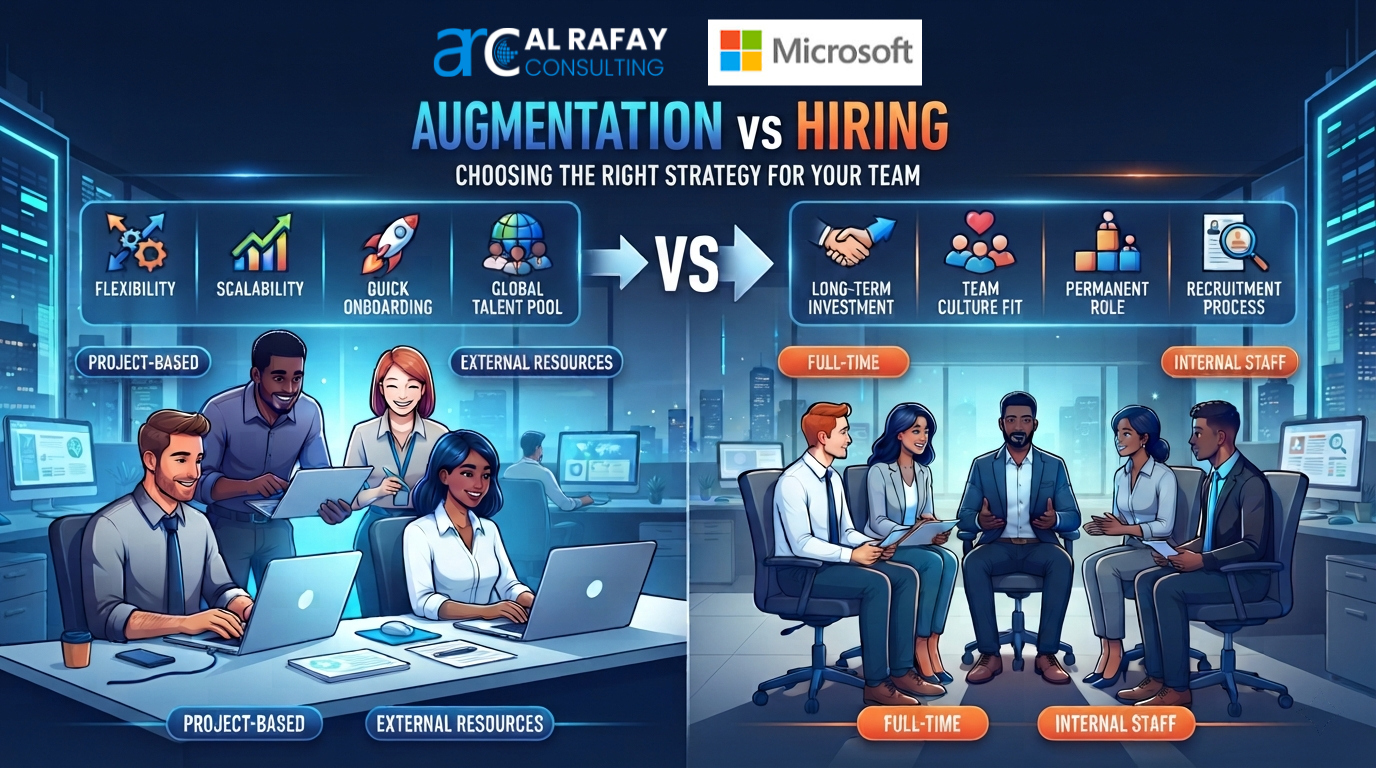
Your roadmap is moving faster than your hiring pipeline. The Azure migration is behind schedule, the Power Platform backlog keeps growing, and the security team is one open incident away from a bad quarter - but your last two developer requisitions have been open for months. So you are left with the same question every IT and business leader eventually asks: do we augment, do we hire, or is there a better way to structure this?
Most content on IT staff augmentation vs hiring treats it as a binary choice: bring in a contractor, or bring on an employee. That framing misses the model most Microsoft-focused organizations actually need once the work stops being a one-time project and becomes ongoing operations - managed IT services.
This guide breaks the decision down properly. You will get a practical comparison of staff augmentation, full-time hiring, and managed services; a decision framework built around duration, risk, and Microsoft operating maturity; real use cases mapped to Azure, Microsoft 365, Power Platform, and Dynamics 365; and a look at where each model quietly fails if you pick wrong.
If you want to review service scope before deciding, see our Managed IT Services solutions page for delivery models, included capabilities, and operating coverage.
Use staff augmentation when speed, niche skills, or project flexibility matter
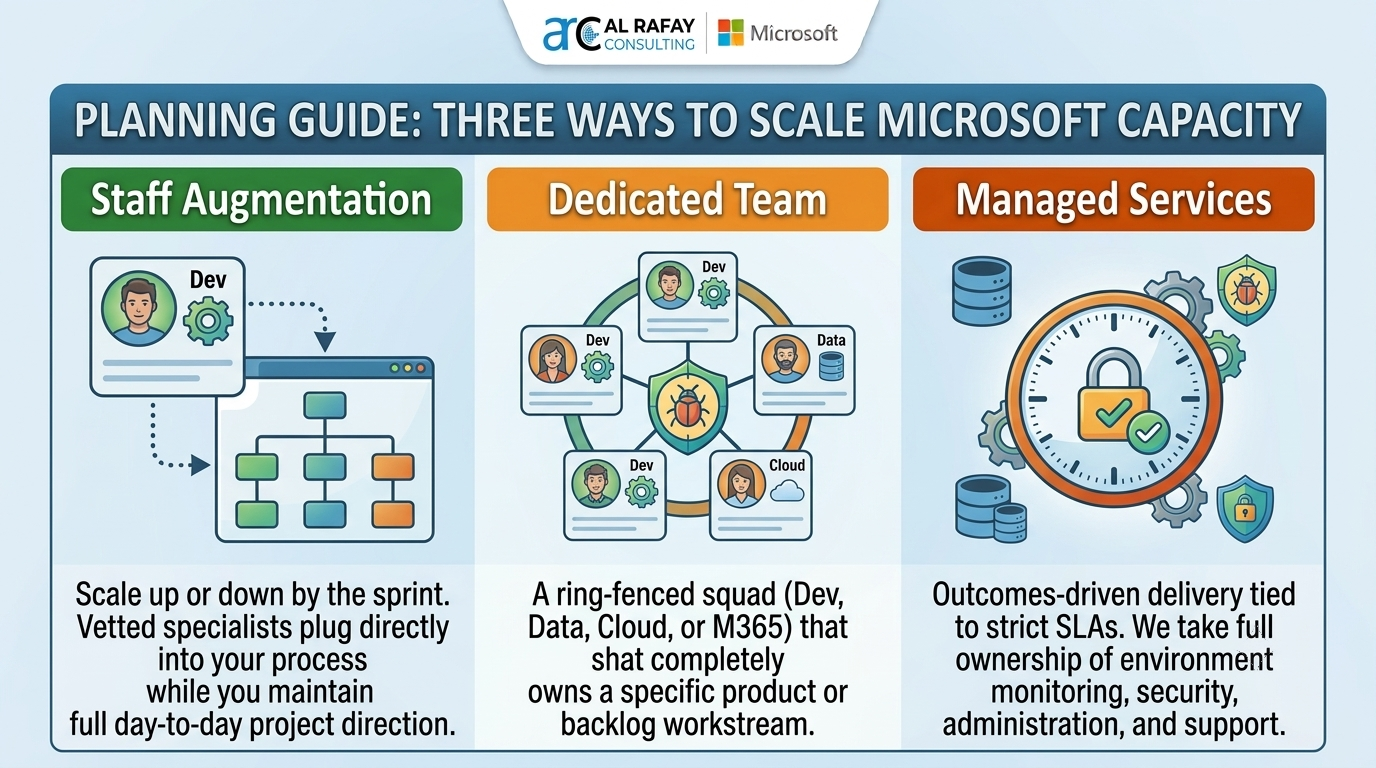
Staff augmentation adds external specialists to your existing team for a defined period. You keep management control and delivery ownership; the augmented staff fill a skills or capacity gap. This is the right call for time-bound work like an Azure migration sprint, a Power Platform backlog sprint, or a security hardening project where you need expertise now and do not want a permanent headcount commitment.
Hire full-time when long-term ownership, culture, and institutional knowledge matter
Full-time hiring makes sense when a role requires deep organizational context, long-term accountability, or platform ownership that should not rotate with a contract cycle - a platform owner, an enterprise architect, or a security governance lead, for example. The tradeoff is time and cost: recruiting, onboarding, and ramp time all delay the value you are hiring for.
Use managed services when the work is continuous, operational, SLA-driven, or Microsoft-platform-heavy
Managed IT services fit best once the work stops being a project and becomes an ongoing operational responsibility - Microsoft 365 administration, Azure monitoring and patching, endpoint management through Intune, or 24/7 security operations. Here, a vendor does not just supply people; it owns delivery against a defined SLA, which is a structurally different commitment than staff augmentation.
| Model | Who manages the work | Best for | Weakest for |
|---|---|---|---|
| Staff augmentation | You | Time-bound projects, niche skills, temporary capacity | Ongoing operations, 24/7 coverage |
| Full-time hiring | You | Long-term ownership, strategic roles, institutional knowledge | Short-term or highly specialized needs |
| Managed IT services | The provider, against an SLA | Continuous Microsoft operations, security, compliance-driven work | One-off projects with a defined end date |
What Is IT Staff Augmentation?
IT staff augmentation is a resourcing model where an external provider places one or more technical specialists inside your team, under your day-to-day direction, for a defined engagement. You control the work; the provider supplies the talent and, typically, the employment relationship.
It is a useful model because it separates two things that full-time hiring bundles together: getting the skill, and taking on the long-term employment commitment. That separation is valuable when a skill gap is real but temporary.
Staff augmentation vs outsourcing
Outsourcing hands over an entire function or project to a third party, which owns the outcome and the process. Staff augmentation only supplies people; your team still owns delivery, project management, and outcomes.
Staff augmentation vs managed services
With staff augmentation, you manage the people; with managed services, the vendor manages the delivery. Augmented staff report into your processes and project management. A managed services provider takes on operational accountability, usually backed by an SLA with defined response times and uptime commitments.
Staff augmentation vs contract-to-hire
Contract-to-hire is staff augmentation with an exit ramp toward full-time employment. It is a reasonable way to de-risk a hiring decision, but it should be deliberate, not a default outcome of every augmentation engagement.
What Is Traditional Hiring / Direct Hire?
Direct hire means bringing someone onto your permanent payroll, with the benefits, culture investment, and long-term commitment that implies. It remains the right model when a role needs sustained ownership over years rather than months.
True cost of hiring: salary, benefits, recruiting, onboarding, ramp time
The advertised salary is rarely the real cost. A full picture of direct-hire cost includes:
- Recruiting cost - sourcing, interviewing, and screening time, plus any agency or job-board fees.
- Benefits and payroll overhead - typically 20% to 40% on top of base salary.
- Onboarding time - weeks before a new hire is fully productive.
- Ramp time - additional months before a specialized technical hire reaches full output.
- Opportunity cost - the work that waits while a requisition stays open.
Where full-time employees create long-term value
Full-time hires build institutional knowledge that does not leave when a contract ends. They can own architecture decisions across multiple years, build relationships across departments, and absorb organizational context that is expensive to re-explain repeatedly.
Side-by-Side Comparison: Staff Augmentation vs Hiring vs Managed Services
| Factor | Staff augmentation | Full-time hiring | Managed IT services |
|---|---|---|---|
| Speed to start | Fast - days to weeks | Slow - 44+ days typical, longer for specialized roles | Fast - onboarding to an existing service, not a person |
| Cost structure | Hourly or fixed-term rate | Salary, benefits, overhead | Recurring service fee, often tiered by SLA |
| Control | High - you direct the work day to day | Highest - full management authority | Lower - vendor owns delivery process |
| Accountability | Shared; you own outcomes | Fully internal | Vendor accountable against SLA |
| Knowledge retention | Limited unless documented | Strong, compounds over time | Institutionalized in provider processes |
| Security/IP exposure | Requires deliberate access controls | Lowest, standard employment protections apply | Requires strong contractual and access governance |
| Flexibility | High - scale up or down quickly | Low - headcount changes are slow and costly | Moderate - tier changes, but contractual |
| Best use cases | Time-bound projects, skill gaps, pilots | Strategic, long-term ownership roles | Continuous, operational, SLA-driven work |
| Microsoft example | Azure migration sprint, Power Platform backlog | Enterprise architect, platform owner | Microsoft 365 admin, Azure monitoring and patching |
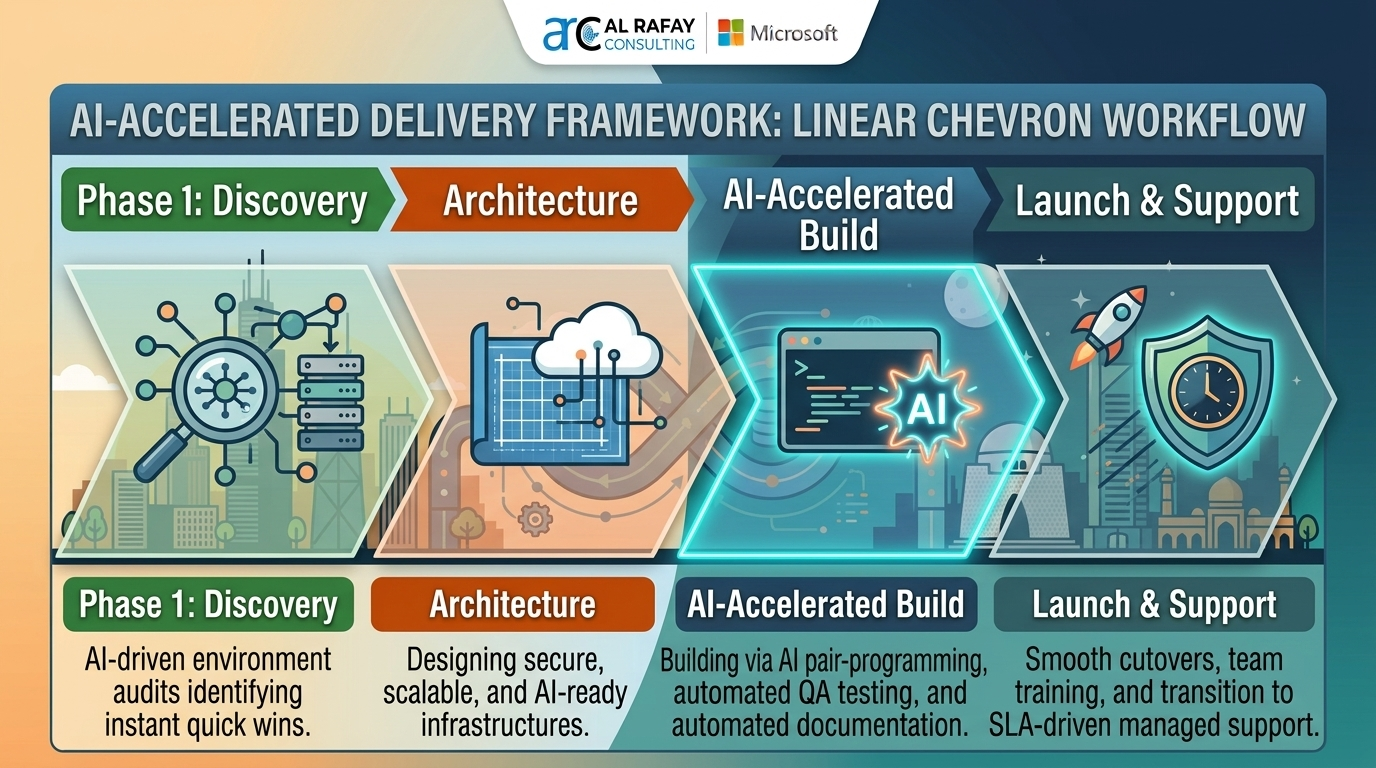
When to Use IT Staff Augmentation
Staff augmentation earns its keep when the need is specific, time-bound, and does not justify a permanent role. Common Microsoft-aligned scenarios include:
- Azure migration sprint.
- Power Platform backlog.
- Dynamics 365 customization.
- Security hardening project.
- AI and automation pilot.
Staff augmentation works best when internal management capacity exists to direct the work day to day.
When to Hire Full-Time
Hiring is the right call when a role represents ongoing, strategic responsibility rather than a defined body of work. Strong candidates for direct hire include:
- Platform owner.
- Enterprise architect.
- Product engineering leadership.
- Security governance owner.
- Long-term internal capability.
When Managed IT Services Are the Better Answer
This is the option most staff augmentation vs hiring comparisons skip entirely, and it is often the most cost-effective path once work becomes continuous rather than project-based.
Microsoft 365 administration
Ongoing tenant administration is rarely a good fit for either augmentation or a dedicated hire. It is steady, specialized, and often best handled by a managed provider already running Microsoft 365 operations at scale.
Azure monitoring, patching, backup/DR, cost optimization
Azure environments need continuous attention: monitoring, patch management, backup and disaster recovery testing, and cost optimization. This is operational work with no natural end date.
Intune endpoint management and security operations
Device compliance, conditional access policies, and endpoint security through Microsoft Intune and Microsoft Defender require constant tuning as your device fleet and threat landscape change.
SLA tiers and response-time expectations
The defining feature of managed services is the SLA. A well-structured engagement should specify uptime commitments, monitoring cadence, and response-time guarantees.
Decision Framework: 7 Questions Before Choosing
Before picking a resourcing model, work through these questions:
- Duration - Is this a defined project with an end date, or ongoing operational work with no natural stopping point?
- Urgency - Do you need capacity in weeks, or can you absorb a long hiring timeline?
- Skill scarcity - Is this widely available or a niche Microsoft specialization?
- Internal management capacity - Does someone on your team have bandwidth to direct external staff day to day?
- Knowledge sensitivity - How much institutional or proprietary context does this role require?
- Compliance risk - Does the work touch regulated data or systems that require contractual accountability?
- SLA requirement - Do you need guaranteed response time and uptime commitments?
If your answers point to temporary, urgent, specific skill - augment. If they point to permanent, strategic, high-context - hire. If they point to ongoing, operational, accountability-driven - managed services is likely your best-value option.
Cost and Risk Checklist
Before signing any engagement, weigh cost against risk, not just hourly rate against salary:
- Calculate true total cost of ownership for each option, including ramp time and management overhead.
- Confirm what happens to IP and access credentials at engagement end.
- Verify security vetting and background standards for external staff touching production systems.
- Check whether SOW/SLA defines ownership of deliverables clearly.
- Ask how knowledge transfer is handled if a contractor or vendor relationship ends.
- Model the cost of not deciding.
How to Transition Between Models
Resourcing decisions are not permanent, and the strongest organizations plan transitions, not just starting points.
- Augment to hire.
- Augment to managed services.
- Managed services to co-managed IT.
Why Microsoft-Focused Companies Need a Microsoft-Aware Resourcing Model
Generic staffing advice treats “a developer” as interchangeable. But Microsoft 365, Azure, Power Platform, and Dynamics 365 are interconnected operating platforms. Resourcing decisions across this stack should be evaluated against the Azure Well-Architected Framework pillars:
- Reliability
- Security
- Cost optimization
- Operational excellence
- Performance efficiency
Get a Microsoft IT Resourcing Assessment
Get a practical recommendation based on your environment, delivery urgency, compliance risk, and Microsoft operating maturity.
Request Your Free Assessment ➡
A resourcing model that ignores these pillars can create gaps that later show up as incidents, cost overruns, or stalled transformation.
Common Challenges and How to Avoid Them
| Challenge | Why it happens | How to avoid it |
|---|---|---|
| Treating augmentation like outsourcing | Buyers assume vendor owns outcomes when vendor only supplies people | Assign clear internal project ownership before engagement starts |
| No security/IP checklist for contractors | Access provisioning gets rushed | Use a standard Microsoft access-control checklist for every external engagement |
| Hiring for temporary work | Urgency pushes teams toward a permanent hire | Apply the 7-question framework before opening a requisition |
| No knowledge transfer plan | Engagements end abruptly | Require a knowledge-transfer deliverable in every SOW |
| Vendor lock-in with managed services | Proprietary tooling or undocumented processes | Negotiate data portability and documented runbooks into the contract |
| Underestimating ramp time | Teams expect immediate productivity | Budget realistic ramp time |
| No SLA clarity | “24/7 support” without defined response times | Insist on specific, measurable response-time and uptime commitments |
Best Practices
- Match the model to the work, not the budget cycle.
- Build a vendor scorecard covering technical vetting, security posture, communication cadence, and references.
- Document a RACI for every engagement.
- Require a defined onboarding checklist for external staff.
- Set a review checkpoint during augmentation engagements.
- Treat SLAs as negotiable, not fixed.
- Reassess annually.
Future Trends
- AI-assisted delivery inside every model.
- Hybrid sourcing as the default.
- Managed services expanding into AI operations.
- Tighter talent markets for specialized Microsoft skills.
- SLA-driven accountability becoming the buying standard.
Conclusion: Choose the Model That Fits the Work
The staff augmentation vs hiring debate is really a question about duration, risk, and ownership - not which option is universally cheaper or faster. Staff augmentation wins for time-bound, specialized project work. Full-time hiring wins for long-term, strategic ownership. For continuous, SLA-driven Microsoft-platform-heavy work, managed IT services frequently outperform both.
Get a Microsoft IT Resourcing Assessment
Al Rafay Consulting will evaluate your current Microsoft environment - Azure, Microsoft 365, Power Platform, Dynamics 365, and security operations - and recommend whether staff augmentation, direct hiring, co-managed IT, or fully managed services is the safest, most cost-effective path forward.
Frequently Asked Questions
What is IT staff augmentation, and how is it different from outsourcing and managed services?
IT staff augmentation adds external specialists into your team under your day-to-day direction, while you keep delivery ownership. Outsourcing and managed services are different because the provider owns outcomes and operational accountability. In managed services specifically, accountability is usually enforced through SLA commitments for response times, uptime, and coverage.
Is staff augmentation cheaper than full-time hiring?
It depends on duration and management overhead. Staff augmentation can be more cost-effective for short, specialized, or urgent work because you avoid long recruiting cycles, benefits overhead, and long-term payroll commitments. Full-time hiring can be better value for multi-year strategic ownership roles where institutional knowledge compounds over time.
Which roles should be augmented versus hired in-house?
Augment project-based or niche skills such as Azure migration specialists, Power Platform backlog teams, or Dynamics 365 implementation experts. Hire in-house for long-term ownership roles such as platform owners, enterprise architects, and security governance leaders. If work is continuous and SLA-driven, managed services is often the better operating model.
How do we protect IP and secure contractor access in a staff augmentation model?
Use formal access governance from day one: least-privilege role assignments, Microsoft Entra ID conditional access, documented onboarding and offboarding checklists, and strict credential revocation at engagement end. Also define IP ownership and deliverable ownership in the SOW so there is no ambiguity when work transitions.
How quickly can augmented IT staff typically start?
Augmented specialists can usually begin in days to weeks, depending on skill availability and security onboarding requirements. That is significantly faster than traditional hiring timelines, where technical roles often require 40+ days to fill, plus onboarding and ramp time before full productivity.

Al Rafay Consulting
ARC Team
AI-powered Microsoft Solutions Partner delivering enterprise solutions on Azure, SharePoint, and Microsoft 365.
LinkedIn Profile