Lakehouse vs Data Warehouse: Which Should You Use and When?
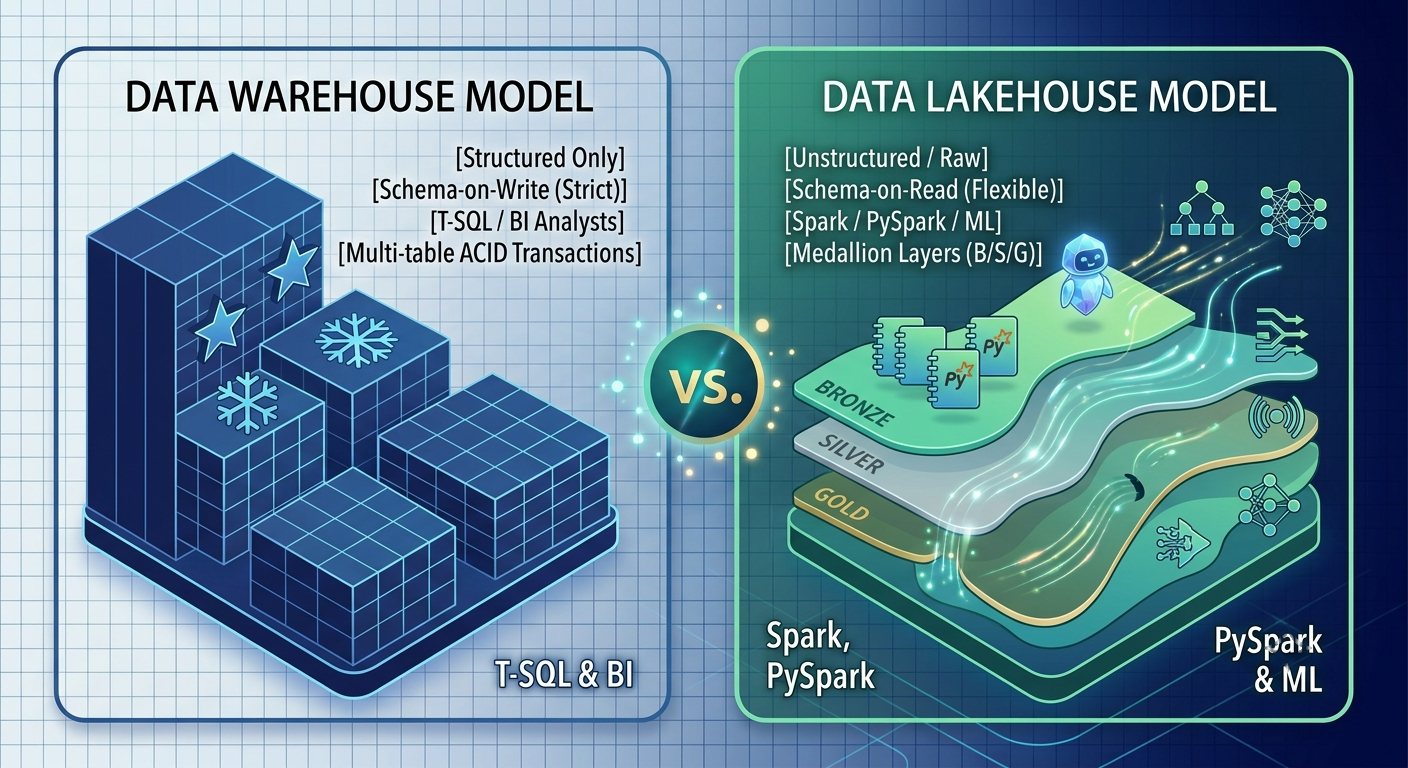
A lakehouse combines data lake flexibility with warehouse-style reliability, while a data warehouse is a structured, SQL-first platform optimized for governed BI reporting.
Compare lakehouse and data warehouse architectures, learn when to use each, and see how Microsoft Fabric and OneLake enable hybrid patterns.
Al Rafay Consulting
· Updated July 15, 2026 · ARC Team
Somewhere between dashboards that keep drifting and AI pilots that fail because data is not ready, most teams hit the same decision point: are we even on the right architecture?
The lakehouse versus data warehouse debate is often framed like a winner-takes-all decision. That framing is wrong. The real question is workload fit: which architecture fits the use case in front of you, and where a hybrid model makes more sense than either side alone.
Quick answer: choose a lakehouse for flexible mixed data, Spark engineering, ML, and streaming. Choose a warehouse for structured SQL BI, dimensional modeling, and strong transactional guarantees. In Microsoft Fabric, many teams use both on top of OneLake.
Need system-to-system connectivity as part of your Fabric architecture? Explore ARC’s B2B Integration Services to connect ERP, CRM, APIs, and partner data flows.
Quick Comparison: Lakehouse vs Warehouse
| Dimension | Data Warehouse | Data Lakehouse |
|---|---|---|
| Data types | Structured, schema-on-write | Structured, semi-structured, unstructured |
| Primary users | BI analysts and SQL developers | Data engineers and ML teams |
| Query language | SQL and T-SQL | Spark plus SQL endpoints |
| Transactions | Full multi-table ACID | Table-level ACID via open formats |
| Performance strength | Predictable BI query performance | Strong engineering and large-scale processing |
| Best fit | Governed BI and reporting | Engineering, ML, and mixed-format pipelines |
What Is a Data Warehouse?
A data warehouse is a structured platform optimized for business intelligence and reporting. Data is modeled before query, commonly in dimensional structures such as star schemas.
Warehouses are the best fit when teams need governed SQL access, predictable performance, and strict reporting controls.
What Is a Lakehouse?
A lakehouse combines data lake flexibility with warehouse reliability features. It supports raw and mixed data while adding ACID capabilities and schema controls through open table formats.
Lakehouse platforms are usually strong for engineering, experimentation, streaming, and AI or ML pipelines.
Lakehouse vs Data Lake vs Warehouse
| Platform | Main Strength | Typical Limitation |
|---|---|---|
| Data lake | Flexible raw storage | Can become ungoverned without discipline |
| Data warehouse | Structured, governed BI | Less flexible for raw and rapidly changing data |
| Lakehouse | Flexible plus reliable open-table processing | Requires strong architecture discipline |
Lakehouse vs Warehouse in Microsoft Fabric
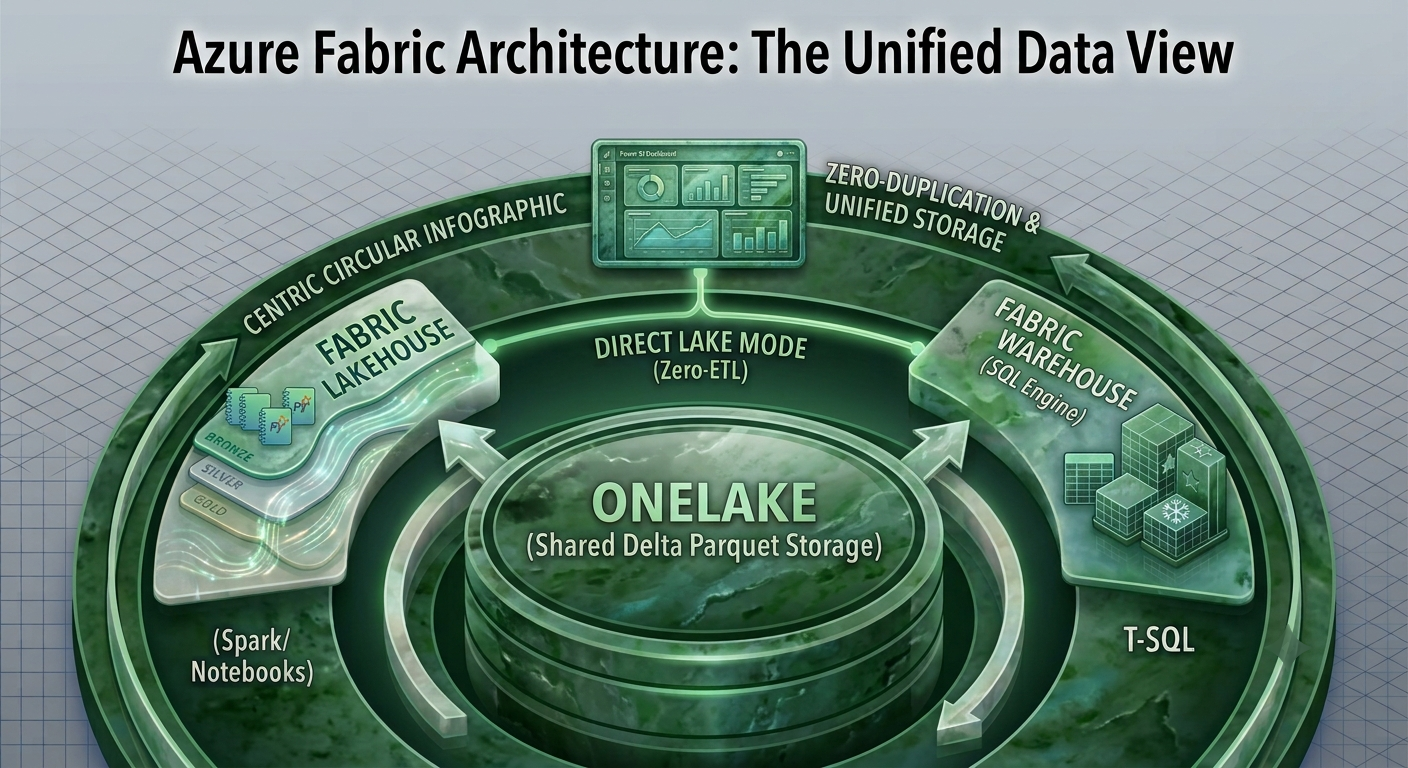
Fabric does not force a binary decision. It provides both experiences on a shared foundation.
OneLake
OneLake is the unified storage layer. Lakehouse and Warehouse both operate on the same underlying data foundation.
Fabric Lakehouse
Fabric Lakehouse is engineering-first, optimized for Spark notebooks, flexible ingestion, and medallion-style processing.
Fabric Warehouse
Fabric Warehouse is SQL-first, optimized for governed relational modeling, BI, and transactional consistency.
Direct Lake and Power BI
Direct Lake lets Power BI access OneLake data without extra duplication layers, reducing lag between data refresh and reporting.
When to Choose a Warehouse
Choose a warehouse when your priorities are:
- Stable structured data
- T-SQL and BI-heavy workflows
- Dimensional modeling and enterprise reporting
- Strong governance and auditability
- Predictable SQL performance
When to Choose a Lakehouse
Choose a lakehouse when your priorities are:
- Mixed, raw, or evolving data formats
- Spark-based transformation pipelines
- Machine learning or data science workflows
- Streaming and near-real-time ingestion
- Flexible schema evolution
When to Use Both
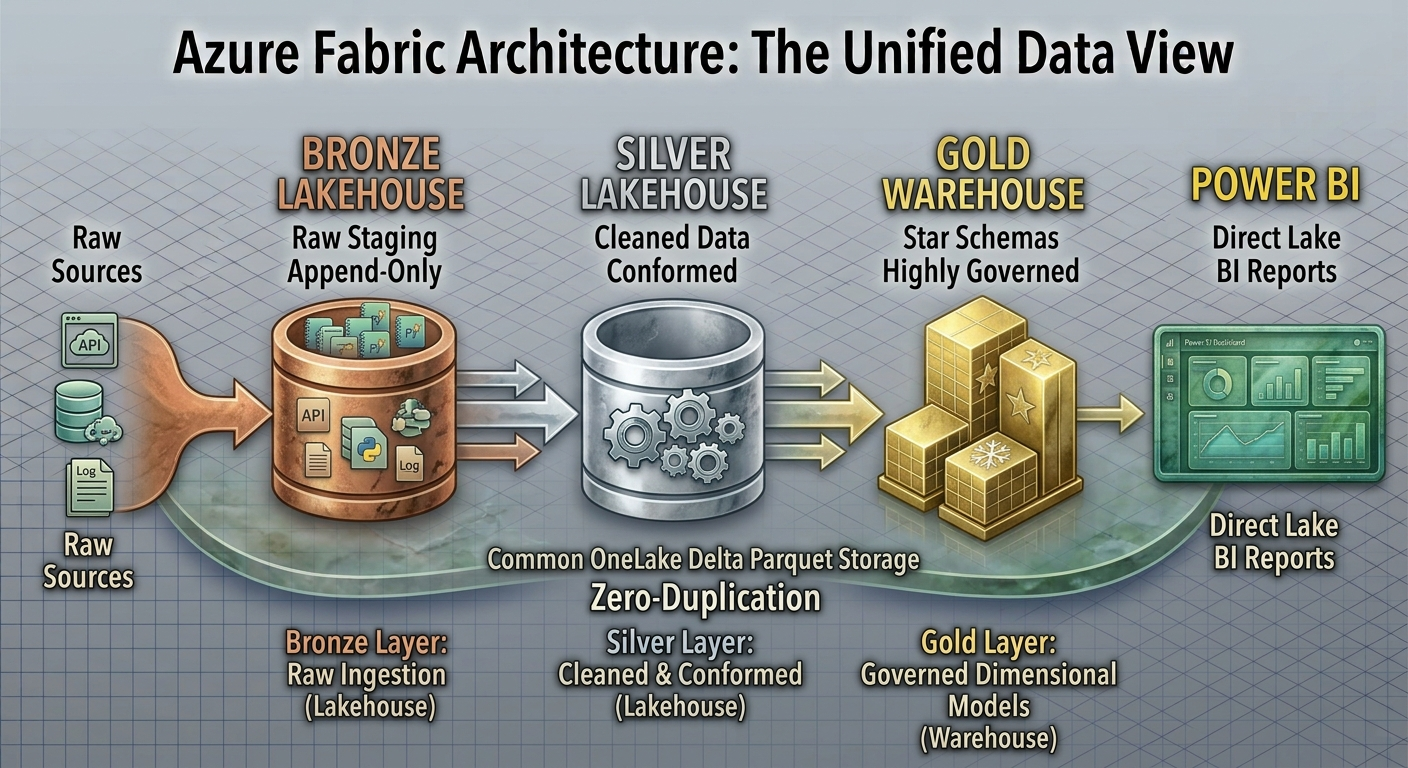
Many Fabric teams use both patterns in one architecture:
- Bronze and Silver data engineering in Lakehouse
- Gold, BI-ready modeling in Warehouse
- Shared consumption through OneLake and Power BI
This approach usually improves flexibility without sacrificing governance.
Decision Framework: 5 Questions
- What data types are involved?
- What are the team’s strongest skills?
- Do you need full multi-table transactions?
- How critical is immediate BI performance?
- What is your AI and ML roadmap?
Answering these per workload is better than forcing one architecture for everything.
Implementation Roadmap in Fabric
Phase 1: Discovery
Assess systems, workloads, and constraints.
Phase 2: Architecture
Map workloads to Lakehouse, Warehouse, or hybrid patterns.
Phase 3: Pilot
Validate one meaningful workload end to end.
Phase 4: Governance
Implement lineage, access controls, and security standards.
Phase 5: Capacity Planning
Right-size capacity using pilot performance data.
Phase 6: Rollout
Scale the validated pattern to additional workloads.
Common Challenges and How to Avoid Them
| Challenge | Why It Happens | How to Avoid It |
|---|---|---|
| Treating the choice as either-or | Teams force all workloads into one model | Decide architecture per workload |
| Data swamp risk | Lakehouse governance is delayed | Enforce medallion structure and ownership early |
| Warehouse dumping ground | Unstructured data is forced into rigid schema | Keep flexible data in lakehouse layers first |
| Duplicate pipelines and copies | No shared storage strategy | Build around OneLake and reuse patterns |
| Governance gaps | Security and lineage added too late | Include governance in architecture phase |
Best Practices
- Decide by workload, not tool loyalty
- Use medallion architecture in lakehouse pipelines
- Promote only stable curated data into warehouse models
- Minimize duplication by using OneLake-native patterns
- Build governance from day one
- Pilot before broad rollout
- Plan for AI and ML readiness early
Key Takeaways
- Lakehouse and warehouse are complementary, not mutually exclusive.
- Warehouse is stronger for structured BI and governance.
- Lakehouse is stronger for flexible engineering and AI readiness.
- Microsoft Fabric enables both on OneLake, reducing duplication and complexity.
- Workload-based architecture decisions deliver better outcomes than one-size-fits-all designs.
Not Sure Which Pattern Fits Your Data Estate?
If you want a practical recommendation for your current environment, ARC can map your workloads to the right Fabric pattern and show where hybrid architecture creates measurable value.
Book a data architecture assessment or explore ARC data engineering services.
Frequently Asked Questions
What is the difference between a lakehouse and a warehouse?
A warehouse is a structured, SQL-first system for governed BI, while a lakehouse supports structured, semi-structured, and unstructured data for engineering, analytics, and ML workloads.
Is a lakehouse better than a data warehouse?
Neither is universally better. The right choice depends on workload fit, data types, team skills, governance needs, and BI or ML priorities.
Do teams need both a lakehouse and a warehouse?
Many mature architectures use both, with lakehouse layers for ingestion and engineering and a warehouse layer for governed BI consumption.
What is OneLake in Microsoft Fabric?
OneLake is Fabric's unified storage foundation that allows lakehouse and warehouse experiences to access shared data without unnecessary duplication.
When should you choose a warehouse first?
Choose a warehouse first when your primary need is structured SQL BI, stable schemas, dimensional models, and predictable reporting performance.
When should you choose a lakehouse first?
Choose a lakehouse first when you need Spark-based engineering, mixed data types, streaming, ML workflows, or evolving schemas.

Al Rafay Consulting
ARC Team
AI-powered Microsoft Solutions Partner delivering enterprise solutions on Azure, SharePoint, and Microsoft 365.
LinkedIn Profile