System Integration Consulting: When Do You Actually Need It?
System integration consulting helps organizations connect ERP, CRM, and line-of-business systems so data moves automatically, accurately, and at scale.
Not sure if you need system integration consulting? See the 7 warning signs, costs, timelines, and how to choose a partner.
Al Rafay Consulting
· Updated July 15, 2026 · ARC Team

If your team spends more time re-entering data than analyzing it, you already have your answer. Somewhere between ERP, CRM, spreadsheets, and cross-team reconciliation messages, your people became the integration layer. That is expensive, error-prone, and impossible to scale.
This is the exact point organizations start searching for system integration consulting. The real question is not “what is integration?” It is “should we do this in-house, or bring in specialists?”
This guide covers the practical signs you need integration consulting, the architecture patterns that actually work in Microsoft-first environments, expected cost and timeline ranges, and how to choose the right partner.
What Is System Integration Consulting?
System integration consulting is the strategy, architecture, and execution discipline required to connect business-critical systems so information flows automatically and reliably.
A strong systems integrator typically helps you:
- Map current-state systems, bottlenecks, and data ownership.
- Design an integration architecture that fits your stack and operating model.
- Build and test integrations across APIs, middleware, and events.
- Implement monitoring, alerting, and support ownership.
- Train internal teams so operations remain sustainable after launch.
What Problems Does Integration Consulting Solve?
Disconnected systems drive compounding operational friction:
- Data silos that prevent a single trusted view.
- Manual data movement that creates delay and error.
- Fragmented architecture after growth or M&A.
- Legacy systems that block modernization and AI initiatives.
When applications do not talk to each other, people fill the gap. That model fails at scale.
7 Signs You Need System Integration Consulting
- Duplicate customer, order, or inventory data entry across systems.
- Reporting takes days because teams reconcile sources manually.
- ERP and CRM disagree on core operational facts.
- M&A left you with overlapping platforms and no shared data model.
- Legacy systems are slowing cloud, automation, or AI roadmaps.
- Workflows stall because teams hand-off information manually.
- Every new region, product, or business line requires custom workarounds.
If your team cannot answer “how many active customers do we have right now” on the same day, you likely have an integration gap.
Common Enterprise Integration Projects
| Project type | What it solves |
|---|---|
| ERP integration | Connects financial, inventory, and operational systems |
| CRM integration | Synchronizes customer, sales, and support processes |
| Dynamics 365 integration | Connects Microsoft ERP/CRM with external systems |
| API integration | Enables real-time application interoperability |
| B2B integration | Automates supplier, vendor, and partner exchanges |
For architecture and delivery support on larger data movement programs, ARC teams often combine integration work with Data Engineering Services.
Microsoft Integration Architecture Explained
For Microsoft-centric organizations, a modern integration layer usually combines:
- Azure Logic Apps for workflow orchestration.
- Azure API Management for API governance and security.
- Azure Service Bus and Event Grid for asynchronous, event-driven reliability.
- Azure Functions and Data Factory for compute and transformation.
- Power Platform for business-led process automation on governed connectors.
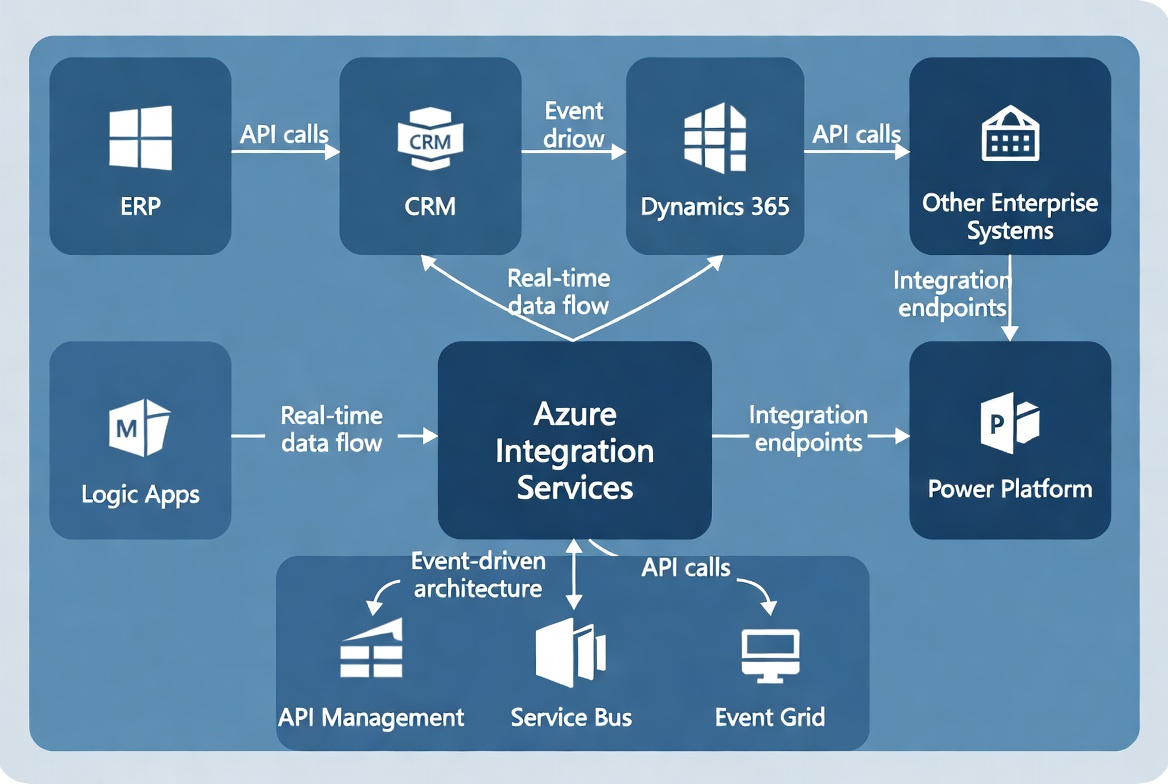
If you are evaluating service boundaries and ownership across low-code and pro-code, review Microsoft Power Platform and Azure Consulting approaches side by side.
Current vs Future State
Current state:
ERP -> Manual export -> Spreadsheet -> CRMFuture state:
ERP <-> Azure Integration Layer <-> CRM <-> Analytics
Build In-House or Hire Consultants?
| Factor | Build in-house | Hire integration consultants |
|---|---|---|
| Integration pattern expertise | Often limited | Deep, project-tested |
| Time to value | Slower | Faster |
| Rework risk | Higher | Lower |
| Maintainability | Depends on bandwidth | Includes enablement and handoff |
| Best use case | Simple known integrations | Multi-system enterprise architecture |
DIY works for single, well-documented integrations. Complex, compliance-sensitive, or business-critical integration programs usually warrant specialist delivery.
Cost and Timeline Expectations
Most engagements follow this shape:
- Discovery and assessment.
- Architecture and delivery planning.
- Build, testing, and hardening.
- Deployment, monitoring, and optimization.
A two-system integration is usually faster and lower cost than a multi-system program with custom transformations, strict compliance controls, and post-M&A rationalization.
Benefits of Professional Integration Consulting
- Automation that removes repetitive re-entry.
- Better visibility from shared data models.
- Higher data accuracy and reduced reconciliation noise.
- Faster reporting cycles.
- Lower operating cost at scale.
- Better AI readiness through cleaner connected data.
For process-heavy operations, this often overlaps with broader Business Process Automation initiatives.
Common Challenges and How to Avoid Them
| Challenge | Why it happens | How to avoid it |
|---|---|---|
| Underestimating data complexity | Legacy structures are inconsistent | Start with deep discovery and mapping |
| Non-scalable integration design | Point-to-point shortcuts | Use API-led and event-driven patterns |
| Weak governance | No ownership after go-live | Define monitoring and support from day one |
| One-time project mindset | Business systems evolve | Plan for extensibility and iteration |
| Low adoption | Change enablement is skipped | Include training, SOPs, and ownership |
| Mismatched partner | Generic IT without platform depth | Vet for enterprise Microsoft integration delivery |
Best Practices
- Run discovery before committing to tooling.
- Define source-of-truth ownership before automation.
- Use real-time event flows where business impact requires it.
- Implement observability from the first release.
- Build with extensibility for future systems and M&A growth.
- Train internal teams before handoff.
- Align architecture with your existing Microsoft estate when practical.
How to Choose a System Integration Consulting Partner
Prioritize partners who can prove outcomes, not just capabilities.
Look for:
- Enterprise integration case evidence.
- Strong Microsoft integration stack depth.
- A structured discovery and architecture methodology.
- Transparent scope and change-control discipline.
- Post-launch support and optimization model.
For knowledge management and collaboration-heavy integration programs, teams often pair integration with SharePoint Consulting and Microsoft Fabric modernization.
Why Organizations Choose Integration Services Instead of DIY
For most organizations running ERP, CRM, and departmental systems at scale, delivery risk and total cost of failed integrations outweigh the cost of doing it right with a specialist partner.
Where appropriate, engage integration services early to reduce rework and accelerate time to reliable operations.
Future Trends to Watch
- Integration as a prerequisite for enterprise AI adoption.
- Hybrid integration as the default architecture model.
- Continued iPaaS expansion and platform consolidation.
- AI-assisted mapping, monitoring, and connector development.
- Event-driven architecture replacing batch-first patterns.
Key Takeaways
- System integration consulting is most valuable when complexity, risk, and scale exceed internal bandwidth.
- Microsoft-first organizations can accelerate delivery using Azure Integration Services plus Power Platform.
- Discovery quality determines architecture quality and long-term maintainability.
- Governance, monitoring, and training are non-negotiable for durable outcomes.
- Early expert involvement usually reduces total cost versus late-stage rework.
Ready to Reduce Integration Friction?
If your team is still bridging systems manually, now is the right time to move to a governed integration architecture.
Publishing Verification Notes
- Internal links were mapped to currently available site routes in this repository.
- Reconfirm external references and any industry statistics at publish time against current source reports.
- Reconfirm ARC credentials and proof points against the latest approved brand claims.
Frequently Asked Questions
What is system integration consulting?
System integration consulting is professional guidance and implementation support for connecting an organization's separate software systems such as ERP, CRM, and e-commerce platforms so they share data and processes automatically instead of through manual work.
When do you need system integration consulting?
You need it when you face duplicate data entry, reporting delays, conflicting sources of truth, post-M&A system fragmentation, legacy-system constraints, workflow bottlenecks, or scaling challenges across business systems.
What does a systems integrator do?
A systems integrator assesses current systems and data flows, designs an integration architecture, builds and tests connections, establishes monitoring and governance, and trains internal teams to maintain the solution.
What systems can be integrated?
Common systems include ERP, CRM, warehouse management systems, HR information systems, supply chain platforms, e-commerce platforms, and custom or legacy applications.
What is enterprise application integration?
Enterprise application integration is the practice of connecting an organization's software applications so they can share data and work as a unified system rather than operating in isolation.
What is the difference between API integration and system integration?
API integration often describes connecting two specific applications through APIs. System integration is broader and connects multiple enterprise systems using APIs, middleware, EDI, and event-driven patterns into one cohesive architecture.
How much does system integration consulting cost?
Cost depends on system count, data complexity, compliance requirements, and integration approach. Most reputable partners start with a scoped assessment before providing firm pricing.
How long does an integration project take?
Timelines vary by scope. A simple two-system integration is generally faster than a multi-system enterprise integration with M&A complexity, custom transformations, or strict governance requirements.
Can legacy applications be integrated?
Yes. Legacy systems can typically be integrated via middleware, custom APIs, adapters, and transformation layers, though architecture and testing discipline are especially important.
What Microsoft tools support integration?
Key Microsoft tools include Azure Logic Apps, Azure API Management, Azure Service Bus, Azure Event Grid, Azure Functions, Azure Data Factory, Power Automate, Dataverse, and Dynamics 365.
What is Azure Integration Services?
Azure Integration Services is Microsoft's integrated platform combining Logic Apps, API Management, Service Bus, Event Grid, and related services for hybrid, enterprise-grade integration scenarios.
What is the difference between iPaaS and middleware?
iPaaS is cloud-native integration infrastructure for building and operating integrations without managing on-premises middleware stacks. Traditional middleware usually refers to self-managed integration software.
Should integration be built internally?
Internal builds can work for simple, well-understood integrations. For multi-system, compliance-sensitive, or high-impact integration programs, consulting support typically reduces risk and rework.
How do you choose an integration consulting company?
Look for proven enterprise integration outcomes, Microsoft platform depth, a structured discovery methodology, transparent scoping, strong references, and clear post-launch support.
What are the biggest integration project risks?
The biggest risks include underestimating data complexity, choosing non-scalable integration patterns, weak post-go-live governance, treating integration as one-and-done, and skipping change management.

Al Rafay Consulting
ARC Team
AI-powered Microsoft Solutions Partner delivering enterprise solutions on Azure, SharePoint, and Microsoft 365.
LinkedIn Profile