Best Commercial Property Management Software (2026): A Complete Buyer's Guide
Commercial property management software is a category of platforms built to manage the leasing, financial, maintenance, and reporting operations of commercial real estate portfolios — office, retail, industrial, and mixed-use properties — as opposed to residential rental management.
Compare commercial property management software for 2026 — CAM, NNN, compliance, AI & Microsoft integration. Read the full buyer's guide.
Al Rafay Consulting
· Updated July 14, 2026 · Commercial Real Estate Technology Consultants
A single missed CAM reconciliation can cost a commercial landlord tens of thousands of dollars in unrecovered operating expenses — and most portfolios are still running that process through spreadsheets stitched together across leasing, accounting, and maintenance teams that don’t talk to each other. If you manage NNN leases, CPI escalations, or percentage rent structures across a mixed-use or multi-tenant portfolio, you already know the real problem isn’t finding software — it’s finding commercial property management software built for the actual complexity of commercial leasing, not residential rent collection with a few extra fields bolted on.
This guide is built as a genuine buyer’s framework, not a vendor popularity contest. You’ll get a breakdown of the features that actually matter for commercial portfolios (CAM, NNN, CPI, percentage rent, compliance), a neutral look at how major platforms differ, a section most competitor guides skip entirely — how commercial PMS fits into a Microsoft-centered technology stack (Dynamics 365, Azure, Power BI) — plus a practical evaluation and implementation framework you can use regardless of which platform you choose.
What Is Commercial Property Management Software?
Commercial property management software is a category of platforms built to manage the leasing, financial, maintenance, and reporting operations of commercial real estate portfolios — office, retail, industrial, and mixed-use properties — as opposed to residential rental management.
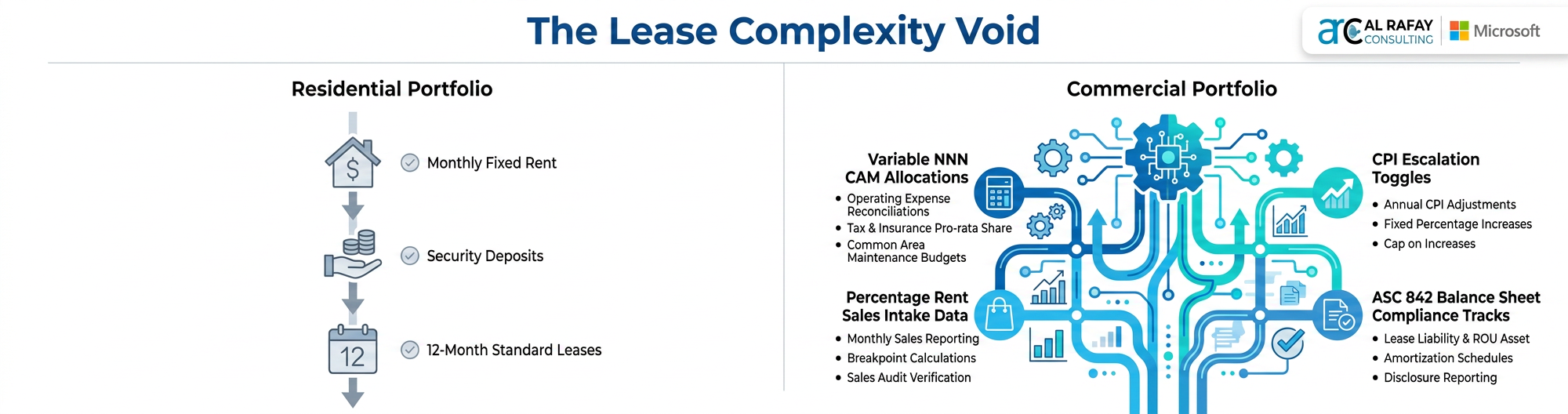
The defining difference from residential property management tools is complexity: commercial leases involve variable structures (triple-net, CPI escalations, percentage rent), shared expense recovery (CAM reconciliation), longer lease terms, and stricter compliance requirements (like ASC 842 lease accounting), all of which residential-focused tools typically aren’t built to handle well.
Why This Matters Now
Commercial real estate operators are under pressure from multiple directions at once: rising expectations for tenant experience, growing compliance complexity, and increasing demand for real-time financial visibility across portfolios. Software that was adequate five years ago — largely digitized spreadsheets — is increasingly being replaced by unified platforms that connect leasing, accounting, maintenance, and reporting into a single system of record.
Feature Deep-Dive: What Commercial Property Management Software Needs to Handle
CAM Reconciliation Explained
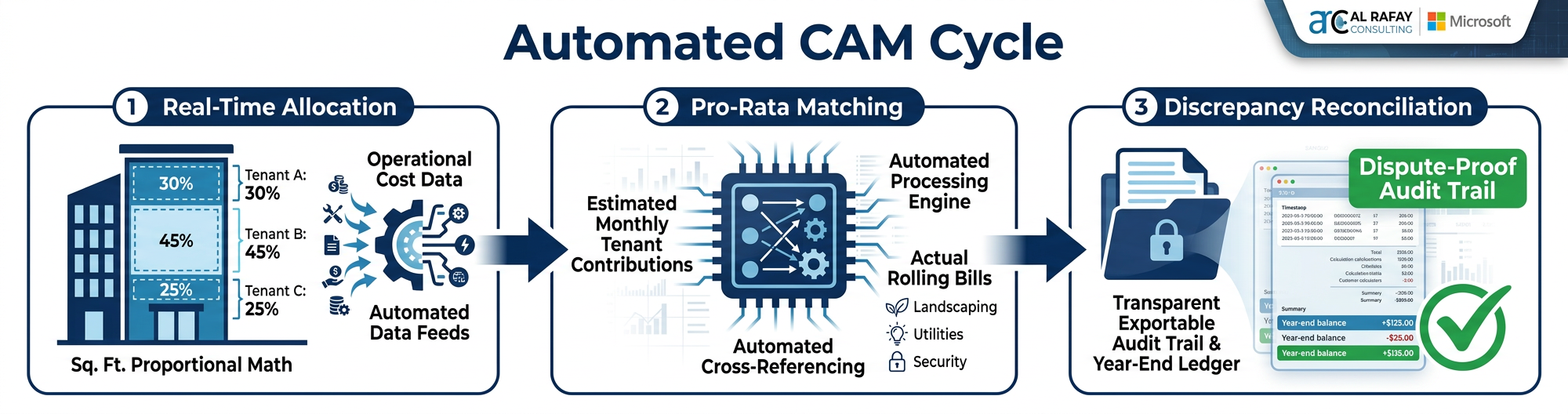
Common Area Maintenance (CAM) reconciliation is the process of calculating each tenant’s share of shared operating expenses — landscaping, security, utilities, repairs — based on their proportional share of leasable square footage, then reconciling estimated payments against actual costs at year-end. This is one of the most error-prone and dispute-generating processes in commercial property management, making automated CAM calculation and audit trails a critical software requirement.
Lease Types Breakdown
| Lease Structure | What It Means | Software Requirement |
|---|---|---|
| Triple-Net (NNN) | Tenant pays base rent plus a share of taxes, insurance, and maintenance | Automated CAM allocation and recovery tracking |
| CPI Escalation | Rent increases tied to the Consumer Price Index | Automated escalation calculations tied to published CPI data |
| Percentage Rent | Rent based partly on a percentage of tenant sales (common in retail) | Sales reporting intake and percentage rent calculation |
| Gross Lease | Landlord covers most operating expenses in a flat rent | Simpler expense tracking, less recovery complexity |
Automated Maintenance Scheduling
Modern commercial PMS platforms increasingly include predictive maintenance capabilities — using equipment data and service history to schedule preventive work before failures occur, rather than relying purely on reactive maintenance requests.
Tenant Experience and Portals
Tenant portals supporting online payments, maintenance requests, document access, and communication have become a baseline expectation rather than a differentiator — the real differentiation now lies in how deeply these portals integrate with back-office accounting and maintenance workflows.
Compliance and Reporting
Lease accounting standards like ASC 842 require organizations to recognize most leases on the balance sheet, making automated compliance reporting a meaningful evaluation criterion for any commercial PMS, particularly for larger portfolios subject to audit requirements.
Vendor Landscape: How Commercial PMS Platforms Generally Differ
The commercial property management software market includes a range of platforms serving different portfolio sizes and needs — from mid-market-focused tools to enterprise-grade platforms used by large institutional owners. Rather than ranking specific vendors (pricing, feature sets, and positioning change frequently and are best verified directly with each vendor), the table below outlines the general categories buyers should evaluate against:
| Evaluation Category | What to Look For | Why It Matters |
|---|---|---|
| Portfolio size fit | Purpose-built for your unit/square-footage scale | Enterprise-grade platforms can be over-engineered (and overpriced) for smaller portfolios, while mid-market tools may lack scalability for large institutional owners |
| Lease complexity support | Native support for NNN, CAM, CPI, percentage rent | Generic or residential-first platforms often handle these as workarounds rather than core functionality |
| Accounting depth | Full general ledger, AP/AR, and financial reporting, or integration with existing accounting systems | Determines whether the PMS can serve as a system of record or needs to sit alongside another finance platform |
| Ecosystem integration | Compatibility with your existing technology stack — ERP, CRM, BI tools | Determines total implementation complexity and long-term data silos |
| AI and automation | CAM automation, predictive maintenance, AI-assisted reporting | Increasingly differentiates modern platforms from legacy digitized-spreadsheet tools |
| Support and SLAs | Defined uptime guarantees, onboarding support, training | Directly affects implementation risk and time-to-value |
When evaluating named platforms (AppFolio, MRI, Yardi, RealPage, DoorLoop, Buildium, Entrata, and others), request current pricing, a live demo scoped to your lease types, and references from portfolios similar in size and complexity to your own — vendor positioning shifts quickly, and marketing claims should always be verified directly against your specific use case.
Microsoft Ecosystem Integration: Dynamics 365, Azure, and Power BI
One of the most underexplored angles in commercial PMS evaluation is how the software fits into an organization’s broader Microsoft technology investment — particularly for organizations that already run finance, operations, or CRM on Microsoft platforms.
Dynamics 365 for Real Estate
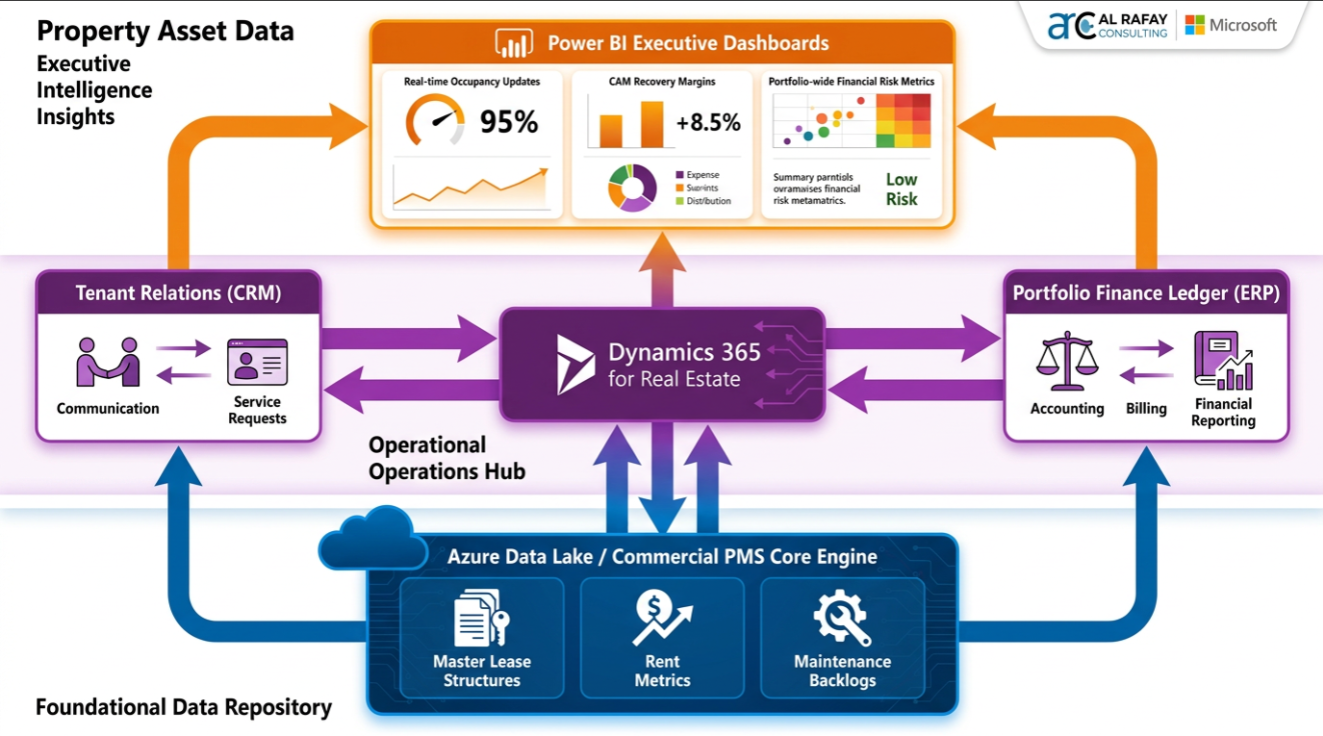
Microsoft’s partner ecosystem includes real estate-focused solutions built on Dynamics 365, combining ERP and CRM capabilities with property-specific functionality — lease management, tenant relationships, and financial operations in a single connected system rather than siloed point solutions. Teams evaluating this route usually start with Dynamics 365 consulting to map fit before platform selection.
Azure and Power BI for Reporting
Organizations running commercial PMS data through Azure and Power BI gain the ability to build custom, real-time dashboards across an entire portfolio — combining occupancy, CAM recovery rates, maintenance costs, and financial performance into unified views that most out-of-the-box PMS reporting tools can’t match. If this is a priority, review Azure integration and business intelligence services.
Why This Matters for Buyers
If your organization already runs Microsoft 365, Dynamics 365, or Azure for other business functions, a commercial PMS that integrates natively into that ecosystem reduces implementation complexity, avoids duplicate data entry, and lets your finance and operations teams work inside familiar tools rather than learning an entirely separate platform.
For a practical architecture example, see CRE Asset Management Software Explained.
Buyer’s Guide: Evaluation, Budgeting, and Implementation
How to Evaluate Platforms by Portfolio Size
| Portfolio Size | Priority Considerations |
|---|---|
| Small-to-mid (under 500,000 sq ft) | Ease of use, cost efficiency, core CAM/NNN support |
| Mid-market (500,000 – 2M sq ft) | Scalability, integration flexibility, dedicated support |
| Enterprise/institutional (2M+ sq ft) | Deep accounting functionality, compliance automation, multi-entity support, ecosystem integration |
Budgeting Considerations
- Per-unit or per-square-foot pricing models are common — confirm whether pricing scales predictably as your portfolio grows
- Ask about implementation and onboarding fees separately from ongoing subscription costs
- Clarify whether premium features (AI tools, advanced reporting, API access) are included or billed separately
- Factor in training time and internal staff hours, not just the software cost itself
Migration Checklist
- Audit existing lease data, CAM history, and financial records for completeness and accuracy
- Map current workflows (leasing → accounting → maintenance) to the new platform’s structure
- Identify integration requirements with existing accounting, CRM, or ERP systems
- Plan a phased rollout (e.g., by property or region) rather than a single portfolio-wide cutover
- Run parallel reporting during transition to validate data accuracy before fully retiring legacy systems
- Train staff on new workflows before go-live, not during it
Before rollout, review client success stories to benchmark what implementation sequencing looks like in real projects.
Common Challenges and How to Avoid Them
| Challenge | Why It Happens | How to Avoid It |
|---|---|---|
| CAM reconciliation disputes | Manual calculations and unclear audit trails | Choose software with automated CAM allocation and transparent, exportable audit trails |
| Data silos between leasing, accounting, and maintenance | Point solutions that don’t integrate | Prioritize platforms with native integration or strong API support across functions |
| Poor tenant adoption of portals | Portal rollout without clear tenant communication or incentive | Pair portal launch with clear tenant onboarding and a defined communication plan |
| Compliance gaps (ASC 842) | Legacy systems not built for current lease accounting standards | Confirm compliance reporting capabilities during evaluation, not after implementation |
| Underestimated implementation timeline | Migration complexity underestimated during vendor selection | Build a realistic migration checklist and phased rollout plan before signing a contract |
| Hidden fees post-contract | Pricing tiers not fully understood at signing | Request a full breakdown of implementation, training, and premium feature costs in writing |
| Low staff adoption after go-live | Training compressed or rushed before launch | Train staff on new workflows before go-live, with defined power users per department |
Best Practices
- Map lease complexity before evaluating vendors. Know exactly which lease structures (NNN, CPI, percentage rent) your portfolio requires support for before comparing platforms.
- Prioritize integration over feature count. A platform with fewer standalone features but strong integration into your existing accounting, CRM, or ERP stack often delivers better long-term value than a feature-heavy but siloed tool.
- Request references from similarly sized portfolios. A platform that works well for a 200,000 sq ft retail portfolio may not scale the same way for a 2M sq ft mixed-use portfolio.
- Treat CAM automation as a must-have, not a nice-to-have. Manual CAM reconciliation is one of the highest-risk, highest-dispute processes in commercial property management.
- Plan your Microsoft ecosystem fit early. If your organization already runs Dynamics 365, Azure, or Power BI, evaluate PMS platforms specifically for how well they integrate into that existing investment.
- Budget for training, not just licensing. Software adoption failures are more often a training problem than a software problem.
- Run a phased migration. Rolling out by property or region reduces risk compared to a single portfolio-wide cutover.
Future Trends
AI Copilots in Leasing and Maintenance
AI-assisted tools are increasingly being built into commercial PMS platforms to support lease abstraction, maintenance triage, and tenant communication — reducing manual work in tasks that were previously entirely staff-driven. Most teams operationalize this through workflow automation and orchestration layers such as Microsoft Power Platform services.
Converged, Single-Platform Ecosystems
The market is shifting away from point solutions (separate tools for leasing, accounting, and maintenance) toward unified platforms that manage the full property lifecycle in one connected system, reducing the data silos that have historically caused reporting inconsistencies.
RegTech and Compliance Automation
As lease accounting standards and regulatory requirements continue to evolve, automated compliance tooling — particularly around ASC 842 and data governance — is becoming a standard expectation rather than a premium add-on.
Cloud-Native SaaS and IoT Integration
Increasingly, commercial PMS platforms are integrating directly with IoT building sensors to support predictive maintenance and real-time occupancy and energy monitoring, moving beyond scheduled maintenance toward condition-based servicing.
Deeper Microsoft Ecosystem Convergence
As more commercial real estate operators run their broader business on Microsoft’s platform stack, expect continued growth in PMS solutions purpose-built on or deeply integrated with Dynamics 365, Azure, and Power BI — reducing the need for separate, disconnected reporting and CRM tools.
Conclusion: Choosing Software That Matches Your Portfolio’s Real Complexity
The right commercial property management software isn’t the one with the longest feature list — it’s the one built to handle the specific lease structures, compliance requirements, and reporting needs of your actual portfolio, and integrated cleanly into the broader technology stack your organization already relies on.
Key takeaways:
- Commercial leases (NNN, CAM, CPI, percentage rent) require purpose-built functionality that residential-focused tools typically can’t match.
- CAM reconciliation automation and audit trails should be treated as a must-have evaluation criterion, given how frequently manual CAM processes generate tenant disputes.
- Integration matters as much as feature count — particularly for organizations already invested in Dynamics 365, Azure, or Power BI.
- A realistic migration plan, including a phased rollout and dedicated training time, is often the difference between successful adoption and a stalled implementation.
- AI-assisted maintenance, lease abstraction, and reporting are becoming standard expectations, not premium differentiators, heading into 2026.
The organizations getting the most value from commercial PMS aren’t just digitizing spreadsheets — they’re building a connected system that ties leasing, accounting, maintenance, and reporting into a single source of truth.
For a deeper provider-selection framework, see CRE Asset Management Software Explained and What Is MRI Software?.
Ready to Evaluate the Right Commercial Property Management Platform?
Al Rafay Consulting helps commercial real estate operators evaluate, implement, and integrate property management software into their broader Microsoft ecosystem — including Dynamics 365, Azure, and Power BI — so your leasing, finance, and operations teams work from a single connected system rather than fragmented point solutions.
Frequently Asked Questions
What is commercial property management software?
Commercial property management software is a platform built to manage the leasing, financial, maintenance, and reporting operations of commercial real estate portfolios, with support for complex lease structures like NNN, CAM, and percentage rent that residential-focused tools typically don't handle well.
What should I look for in CAM reconciliation features?
Look for automated CAM allocation based on tenant square footage, transparent and exportable audit trails, and the ability to reconcile estimated versus actual expenses at year-end without manual spreadsheet work.
How does commercial PMS handle NNN and CPI leases?
Purpose-built commercial platforms support automated triple-net expense recovery calculations and CPI-based rent escalations tied to published index data, rather than requiring manual calculation outside the system.
Can commercial property management software handle percentage rent structures?
Yes — platforms built for retail-heavy portfolios typically include percentage rent calculation based on tenant-reported sales data, though this capability varies significantly by vendor and should be confirmed during evaluation.
Does commercial PMS integrate with Dynamics 365 and Power BI?
Some commercial property management solutions are built directly on or integrate with Dynamics 365, Azure, and Power BI, allowing organizations already running Microsoft's ecosystem to unify property data with broader financial and operational reporting.
What are typical pricing models for commercial PMS?
Pricing is commonly structured per unit or per square foot, with implementation and training often billed separately from ongoing subscription costs — always request a full, itemized quote before comparing vendors.
What compliance tools should I expect (ASC 842, data governance)?
Look for built-in lease accounting reporting aligned to ASC 842 requirements, along with data governance and security certifications appropriate to your organization's regulatory environment.
How does commercial PMS compare to residential property management software?
Commercial PMS is built to handle more complex lease structures, longer terms, CAM reconciliation, and stricter compliance requirements, while residential platforms are typically optimized for simpler, shorter-term rental agreements.
What does a typical migration to a new commercial PMS involve?
A typical migration includes a full data audit of existing leases and financials, workflow mapping, integration planning, a phased rollout by property or region, parallel reporting for validation, and staff training before go-live.
Is AI a standard feature in commercial property management software now?
AI capabilities — particularly for maintenance prediction, lease abstraction, and reporting assistance — are becoming increasingly common in modern platforms, though the depth and maturity of these features still varies significantly across vendors.
How scalable is commercial PMS for mixed-use portfolios?
Scalability varies by vendor; mixed-use portfolios should specifically evaluate whether a platform can handle the differing lease structures and reporting needs of retail, office, and residential components within a single connected system.
What questions should I ask about hidden fees?
Ask specifically about implementation fees, training costs, premium feature add-ons, API access charges, and whether pricing scales predictably as your portfolio or user count grows.

Al Rafay Consulting
ARC Team
AI-powered Microsoft Solutions Partner delivering enterprise solutions on Azure, SharePoint, and Microsoft 365.
LinkedIn Profile