Contract Automation ROI: Building the Business Case for Contract Automation Software
Contract automation ROI is the measurable financial return from automating contract creation, approvals, tracking, and renewals through time savings, risk reduction, revenue protection, and compliance gains.
See how contract automation software delivers measurable ROI through faster cycles, reduced risk, and protected revenue. Get the business case.
Al Rafay Consulting
· Updated July 17, 2026 · ARC Team
Every CFO has asked some version of the same question when a new software line item lands on their desk: “What does this actually save us?” For contract automation software, that question has a real, quantifiable answer, and it is a stronger one than most finance leaders expect.
Manual contract management is not just slow. It is a quiet, ongoing drain on revenue, margin, and compliance posture that rarely shows up as a single line item anywhere, which is exactly why it survives budget review after budget review. This guide makes the financial case: how contract automation software generates measurable ROI through faster cycle times, reduced risk, protected revenue, and stronger compliance, how to calculate that ROI for your organization, and what that automation looks like when built on the Microsoft ecosystem many enterprises already run on.
If you are building an internal business case for legal, procurement, finance, or executive leadership, this is the framework to use.
Why Contract Automation ROI Matters
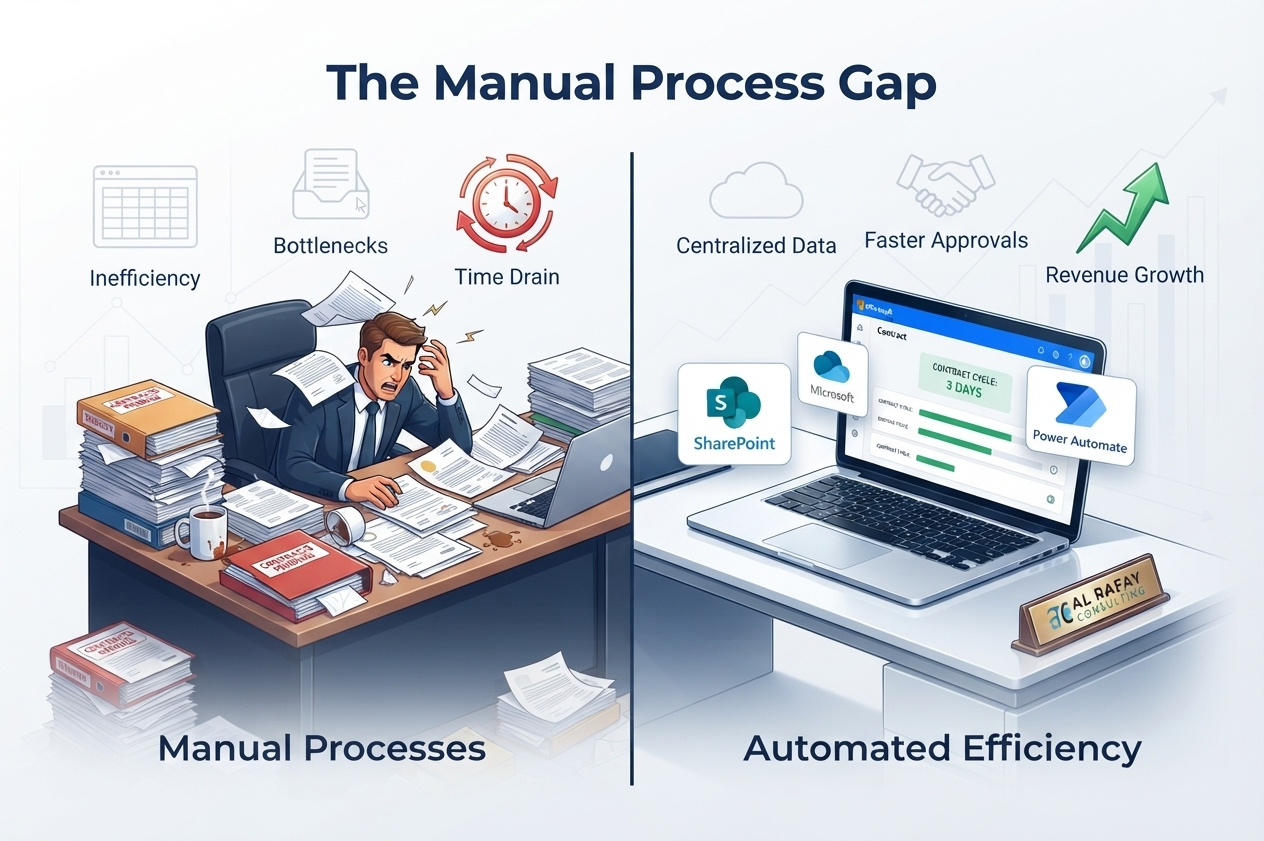
The Hidden Costs of Manual Contract Management
Manual contract processes rarely fail loudly. They fail quietly, in ways that often never get traced back to the source:
- Legal teams spend hours redrafting near-identical agreements instead of reusing approved templates.
- Approvals stall in inboxes because there is no defined routing logic or escalation path.
- Renewal dates get missed because no one owns tracking.
- Obligations negotiated into contracts are never enforced because no system tracks them post-signature.
- Procurement loses negotiating leverage because auto-renewals are flagged too late.
None of these shows up as a single expense line, but together they represent real, recoverable value. Research from World Commerce & Contracting estimates organizations lose an average of 8.6% of contract value to poor contract management practices.
The Cost of Doing Nothing
The most under-discussed number in any ROI conversation is the cost of the status quo. Every quarter spent on manual processes compounds missed renewals, delayed deal closures, and unenforced obligations. Framed correctly, doing nothing is not neutral; it is an ongoing cost.
How Contract Automation Software Creates ROI
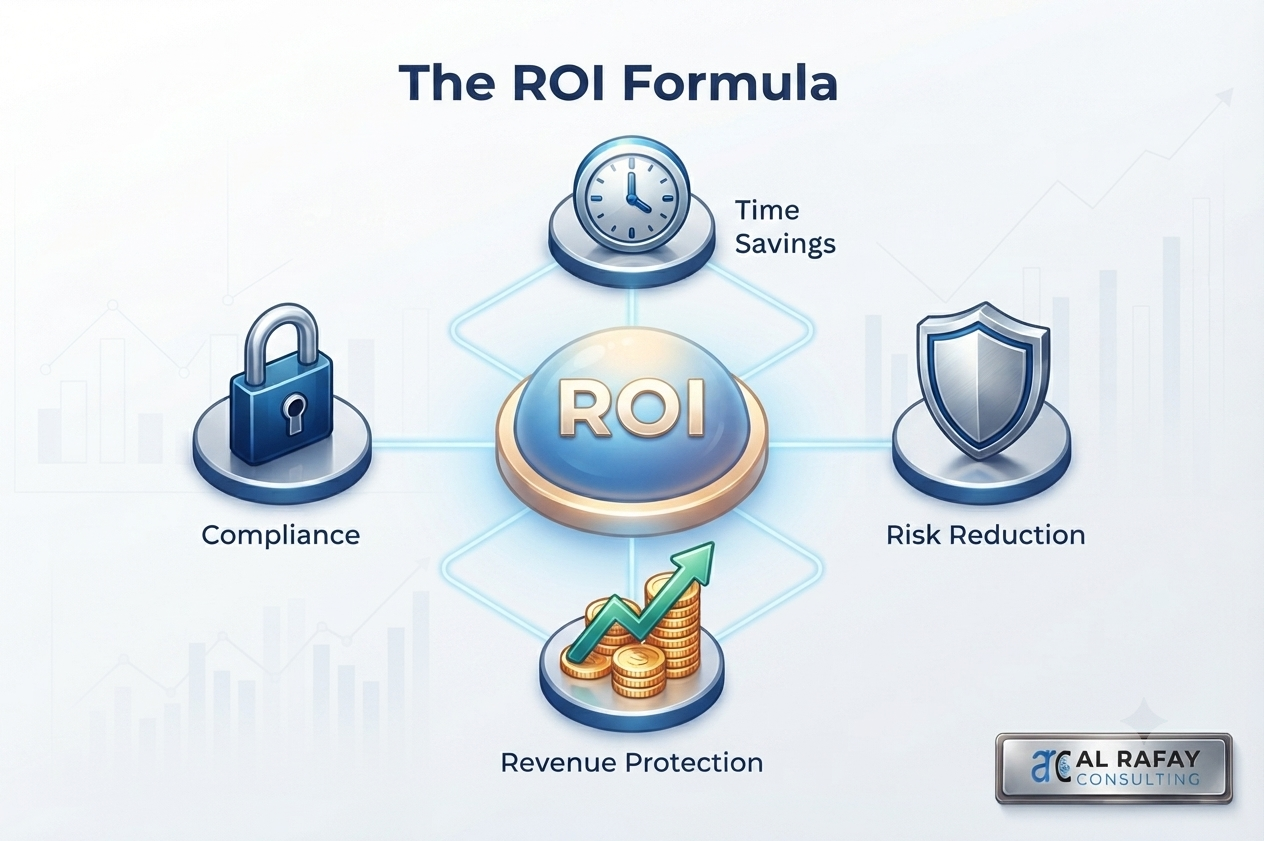
Contract automation software generates measurable return through four connected mechanisms.
Time Savings
Automated templates, clause libraries, and configurable approval routing eliminate manual drafting and email chasing that consume legal and procurement bandwidth.
Risk Reduction
Standardized templates and risk-based approval workflows reduce the chance that non-standard clauses, missed obligations, or unauthorized terms slip through.
Revenue Protection
Automated renewal alerts and obligation tracking directly prevent two common sources of loss: unfavorable auto-renewals and unenforced rebates, credits, or discounts.
Compliance Improvements
A centralized, governed repository with audit trails and consistent retention policies makes compliance and audit readiness part of the operating model.
5 Revenue Leaks Contract Automation Eliminates
- Auto-renewals with unfavorable terms.
- Unenforced rebates and discounts.
- Missed SLA penalties and credits.
- Duplicate or redundant vendor spend.
- Delayed deal execution.
World Commerce & Contracting also identifies post-signature failures as a major loss driver, estimating about 11% of contract value can be lost when obligations and terms are unmanaged after execution.
Calculating Contract Automation ROI
ROI Formula
A practical framework:
ROI = (Total Value Gained - Total Investment) / Total Investment x 100
Where total value gained includes:
- Direct labor savings (hours reclaimed x fully loaded hourly cost)
- Revenue protected from prevented auto-renewals and enforced obligations
- Reduced risk and compliance exposure
- Faster deal-cycle value from shorter approval times
Direct Savings
Direct savings are usually easiest to quantify:
- Less time drafting, reviewing, and chasing approvals
- Lower outside counsel spend for routine agreements
- Lower administrative overhead for renewals and obligations
Indirect Savings
Indirect savings are harder to isolate but often larger over time:
- Better negotiating leverage from renewal visibility
- Lower risk exposure from standardized language and controls
- Faster revenue recognition from shorter approval cycles
- Better allocation of legal and procurement resources
Industry benchmark studies based on Forrester TEI methodology report ROI in the range of 261% for CLM investments, with payback periods under 14 months. These are reference points; actual outcomes vary by organization size, contract volume, and process maturity.
ROI by Department
Contract automation ROI compounds across teams.
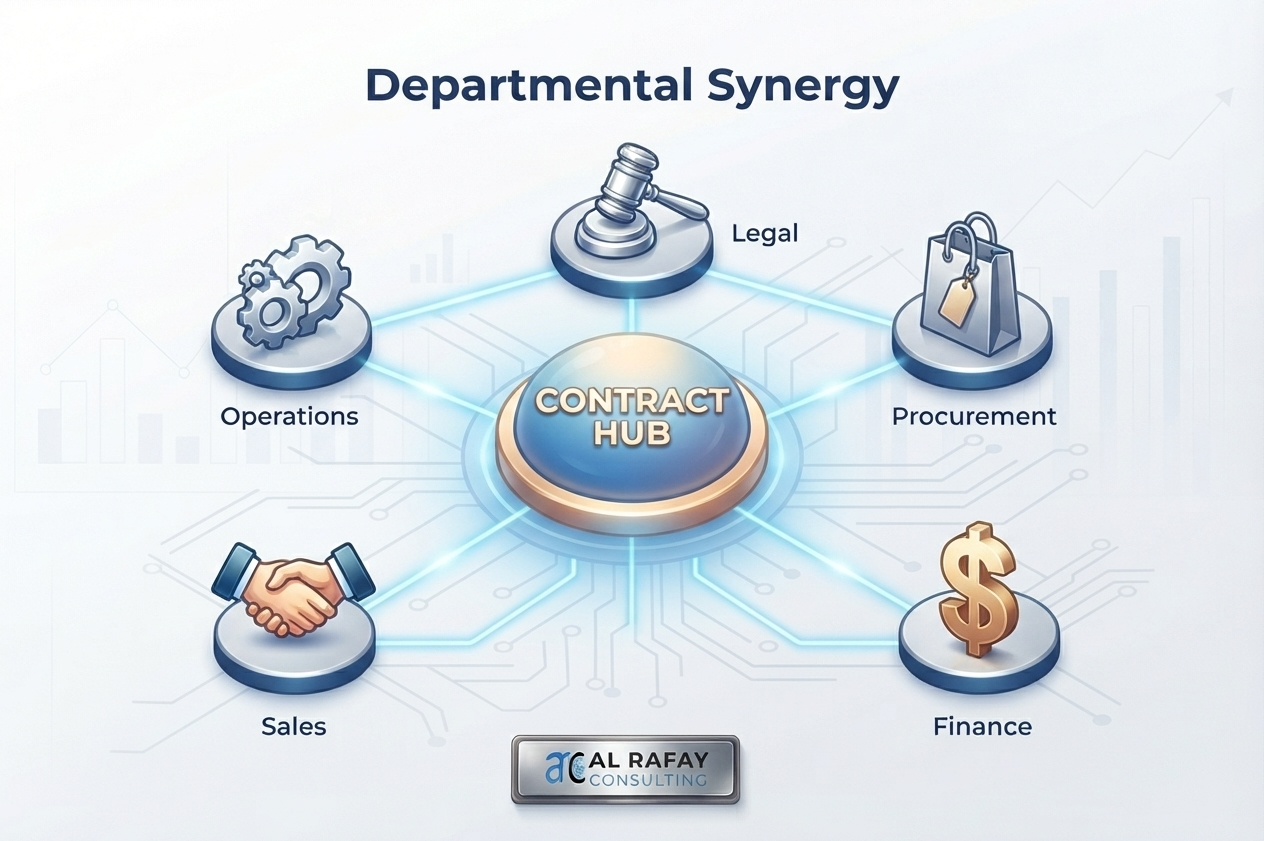
| Department | Where ROI Shows Up |
|---|---|
| Legal | Reduced drafting time, lower outside counsel spend, faster review cycles, stronger audit trail |
| Procurement | Better renewal visibility, stronger negotiating leverage, reduced duplicate spend, faster onboarding |
| Finance | Better revenue and spend forecasting, protected margin from enforced obligations |
| Sales | Shorter deal cycles, faster revenue recognition |
| Operations | Clearer ownership and accountability for contract-linked deliverables and SLAs |
Microsoft-Powered Contract Automation ROI
For organizations already on Microsoft 365, contract automation ROI can be captured without introducing an entirely separate platform, reducing incremental licensing, integration overhead, and training costs.
SharePoint
A governed SharePoint repository reduces time lost to contracts scattered across drives and inboxes. For implementation patterns, see SharePoint contract management.
Power Automate
Risk-based approval routing in Power Automate directly reduces cycle time. Microsoft implementation details are available in Power Automate approvals documentation.
Power Platform
Structured intake apps built on Power Platform replace ad hoc requests. Explore ARC delivery capabilities in Power Platform services.
Microsoft Purview
Retention labels and records controls reduce audit response cost and risk. See Microsoft Purview records management guidance.
Microsoft-Native ROI Levers at a Glance
| Microsoft Tool | ROI Lever |
|---|---|
| SharePoint | Reduced time locating and managing contract versions |
| Power Automate | Faster approval cycles, reduced administrative labor |
| Power Platform | Structured intake reduces upfront delay |
| Microsoft Purview | Lower compliance and audit response cost |
| Dynamics 365 | Connects contract value to CRM and ERP revenue and spend data |
Business Case Example
Consider a mid-sized organization processing around 500 contracts per month with mostly manual review and approval. If automation meaningfully reduces preparation time and captures only part of the value typically lost to missed renewals and unenforced obligations, the combined effect can outweigh software and implementation costs within the first 12 to 14 months.
The exact result depends on volume, maturity, and adoption speed. That is why executive teams respond best to organization-specific models built from baseline metrics, not benchmark averages alone.
Why Organizations Choose Contract Lifecycle Management Platforms
Many organizations solve this through contract lifecycle management platforms rather than piecemeal tools. CLM addresses intake, drafting, approval, execution, obligations, and renewals as one governed system, which closes the expensive gaps between disconnected tools.
How CAMP Helps Reduce Contract Costs
ARC’s CAMP (AI Contract Automation and Lifecycle Management) platform is designed to capture these ROI levers through AI-assisted drafting, automated obligation and renewal tracking, configurable approvals, e-signature, and an audit-ready repository on top of Microsoft 365.
For a real deployment outcome, review the CAMP contract automation case study.
For AI document extraction and contract field capture, ARC also provides intelligent document processing capabilities.
Common Challenges and How to Avoid Them
| Challenge | Why It Happens | How to Avoid It |
|---|---|---|
| Underestimating indirect savings | Models focus only on labor savings | Explicitly model revenue protection and risk reduction |
| No baseline metrics | Teams do not capture current cycle time or renewal capture before rollout | Establish baseline KPIs first |
| Tool-first mindset | Software is added without workflow redesign | Redesign intake, approval, and ownership models |
| Ignoring adoption costs | ROI assumes immediate full usage | Include realistic ramp-up and training costs |
| Overpromising outcomes | Benchmarks are treated as guarantees | Use conservative assumptions tied to your own data |
| Weak cross-functional buy-in | Legal-led rollout omits procurement, finance, or sales needs | Align requirements across all contract-touching teams |
Best Practices
- Establish baseline metrics before automation starts.
- Build a conservative, organization-specific ROI model.
- Include indirect savings, not just labor reductions.
- Prioritize renewal and obligation tracking early.
- Leverage existing Microsoft 365 investments.
- Pilot one contract type before scaling.
- Revisit the ROI model after implementation.
Future Trends
- AI-assisted drafting, review, extraction, and obligation monitoring
- Predictive renewal and risk analytics
- Deeper Microsoft 365 and Dynamics 365 native integration
- Ongoing ROI tracking as a standard operating practice
Conclusion: The Financial Case for Contract Automation
Contract automation software is not merely a legal convenience; it is a measurable financial decision. Industry evidence is directionally consistent: poor contract management erodes value, post-signature failures are costly, and well-implemented automation can produce strong return and short payback windows.
Key takeaways:
- Manual contract management creates hidden cost in labor, missed renewals, and unenforced obligations.
- ROI is driven by time savings, risk reduction, revenue protection, and compliance improvement.
- Strong business cases include both direct and indirect value.
- ROI compounds across legal, procurement, finance, sales, and operations.
- Microsoft-native architectures can reduce total cost of ownership.
Ready to Calculate Your Contract Automation ROI?
If you are building an internal business case for contract automation software, the fastest path to executive buy-in is using your own numbers, not benchmarks alone.
Al Rafay Consulting helps legal, procurement, and finance teams quantify the value trapped in manual contract processes and implement a governed workflow on Microsoft 365.
Request a Free Contract Automation ROI AssessmentFrequently Asked Questions
What is contract automation software?
Contract automation software automates contract creation, approval routing, execution, and post-signature management, reducing manual drafting, chasing approvals, and tracking obligations by hand.
What ROI does contract automation provide?
Industry benchmark studies modeled on Forrester's Total Economic Impact methodology have reported average ROI figures around 261% for CLM investments, though actual returns vary based on contract volume, process maturity, and organization size.
How is contract automation ROI measured?
ROI is measured by comparing total value gained, including labor savings, revenue protected, reduced risk exposure, and faster deal cycles, against total investment in software, implementation, and training.
What is the average payback period for contract automation software?
Forrester-based benchmark studies report payback periods under 14 months, though this depends heavily on contract volume and how quickly an organization adopts the new workflow.
How much revenue is lost through poor contract management?
World Commerce & Contracting research estimates average value erosion of 8.6% from poor contract management, with the worst-performing organizations losing more than 20%, and roughly 11% lost specifically from post-signature failures.
Does contract automation improve compliance?
Yes. A centralized, governed repository with consistent retention policies and full audit trails significantly reduces the labor and risk associated with compliance and audit response.
Can contract automation software reduce legal costs?
Yes, primarily by reducing time spent on repetitive drafting and review, and by lowering reliance on outside counsel for standard, templated agreements.
How does contract automation help procurement teams?
Automated renewal alerts and a centralized repository give procurement visibility into upcoming renewals and existing vendor terms, improving negotiating leverage and reducing duplicate spend.
Can automation prevent missed renewals?
Yes. Automated renewal alerts, typically configured 60 to 90 days in advance, are one of the most direct and measurable ROI levers in contract automation.
Can SMBs achieve meaningful ROI from contract automation?
Yes. While enterprise organizations see the largest absolute savings due to higher contract volume, mid-sized and smaller organizations can still achieve meaningful ROI, particularly from reduced missed renewals and faster approval cycles.
How do I build a business case for contract automation software?
Start by establishing a current-state baseline covering cycle time, cost per contract, and renewal capture rate, then apply the ROI formula using both direct labor savings and indirect value such as revenue protection and risk reduction.

Al Rafay Consulting
ARC Team
AI-powered Microsoft Solutions Partner delivering enterprise solutions on Azure, SharePoint, and Microsoft 365.
LinkedIn Profile