API Integration Services: A Practical Guide
API integration services connect enterprise systems through governed, secure, and maintainable integrations that automate data movement and workflows.
A practical guide to API integration services: architecture, Azure implementation, security, costs, and how to choose a partner.
Al Rafay Consulting
· Updated July 15, 2026 · ARC Team
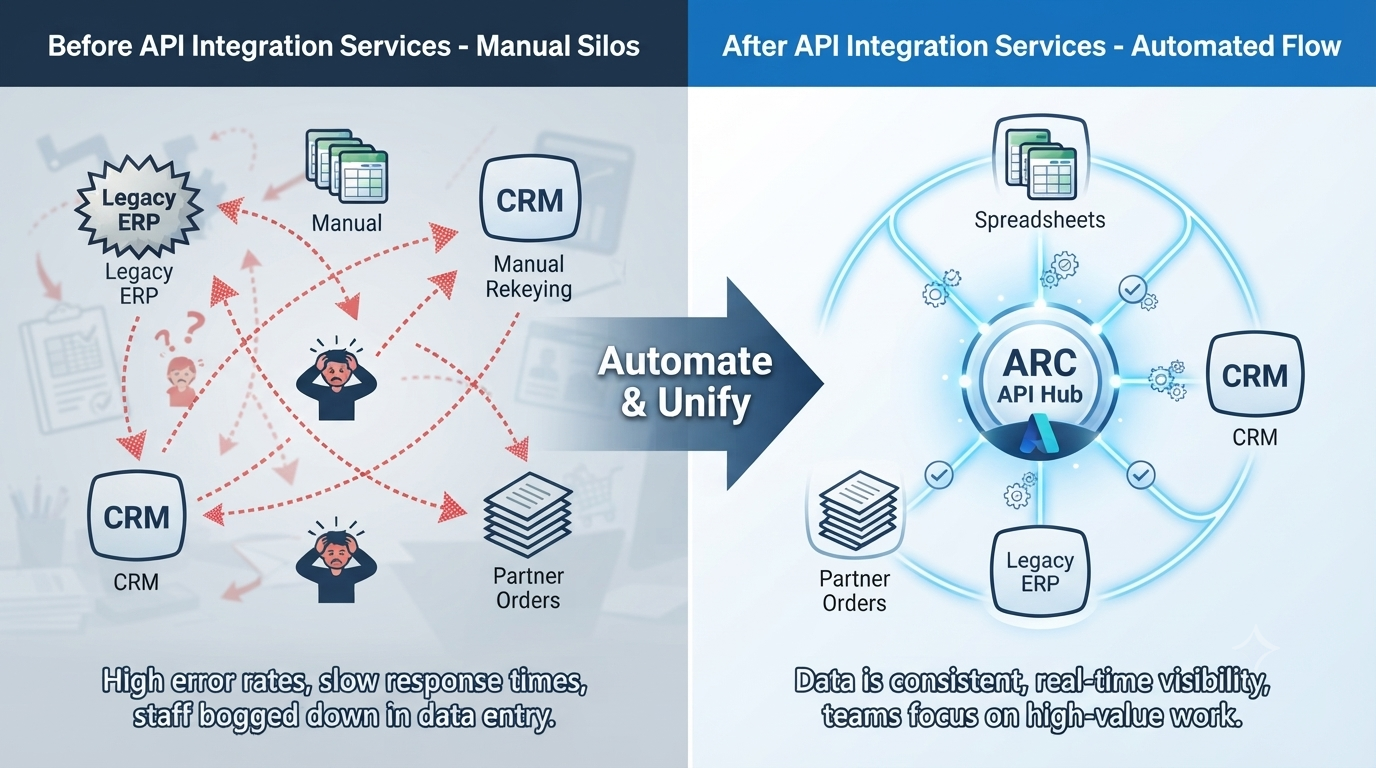
Your ERP has one version of the customer record. Your CRM has another. Your partner portal is waiting on data that is still sitting in a spreadsheet someone forgot to send.
If this sounds familiar, the problem usually is not a single application. The problem is disconnected systems and fragile handoffs.
A mature integration service strategy connects applications, data platforms, and partner ecosystems so information moves automatically instead of through manual rekeying and spreadsheet reconciliation.
This practical guide explains what API integration services actually include, how Azure-based integration architecture is typically implemented, and how to choose the right delivery model and partner.
What Are API Integration Services?
API integration services connect disparate software systems through APIs so data and business events move reliably between applications.
The outcome is not just a one-time connection. It is an operational integration layer with governance, monitoring, ownership, and change management.
API Integration vs. API Management vs. iPaaS vs. Custom Development
| Approach | What it does | Best fit |
|---|---|---|
| API integration services | Connects specific systems and workflows with ongoing support | ERP-CRM sync, partner exchanges, process automation |
| API management | Governs, secures, versions, and monitors APIs at scale | Organizations exposing many APIs internally or externally |
| iPaaS | Uses low-code tooling and pre-built connectors to accelerate integration delivery | Teams needing many standard integrations quickly |
| Custom development | Bespoke integration code for unique constraints and legacy edge cases | Highly specific requirements beyond off-the-shelf connectors |
For a related enterprise-level perspective, see system integration consulting.
When Does an API Call Become an Integration Service?
A single API call is a technical action. An integration service is what exists when that connection is designed, secured, documented, monitored, and supported as part of a business process.
That is where many internal DIY projects break down: the first call works, but long-term reliability fails when schemas change, tokens expire, or upstream systems throttle requests.
Common Use Cases
- ERP-CRM synchronization for customer, order, and inventory consistency.
- Partner portal integrations for real-time status visibility.
- Supply chain data exchange across external systems.
- Hybrid EDI + API operations for mixed modern and legacy partner ecosystems with EDI Supply Chain demands.
- Low-code extension patterns through Power Platform connectors.
- AI-ready data access through governed endpoints for Microsoft Copilot Studio and AI Agents initiatives.
Why Enterprises Invest in API Integration Services
Operational Efficiency and Automation
Automated flows remove repetitive manual data entry and reduce cycle times across operations, finance, and customer-facing teams.
Data Consistency and Real-Time Visibility
When integration is built correctly, teams align around shared, current data instead of reconciling conflicting reports.
Customer, Partner, and Employee Experience
Faster onboarding, quicker response times, and fewer fulfillment errors all depend on reliable system-to-system coordination.
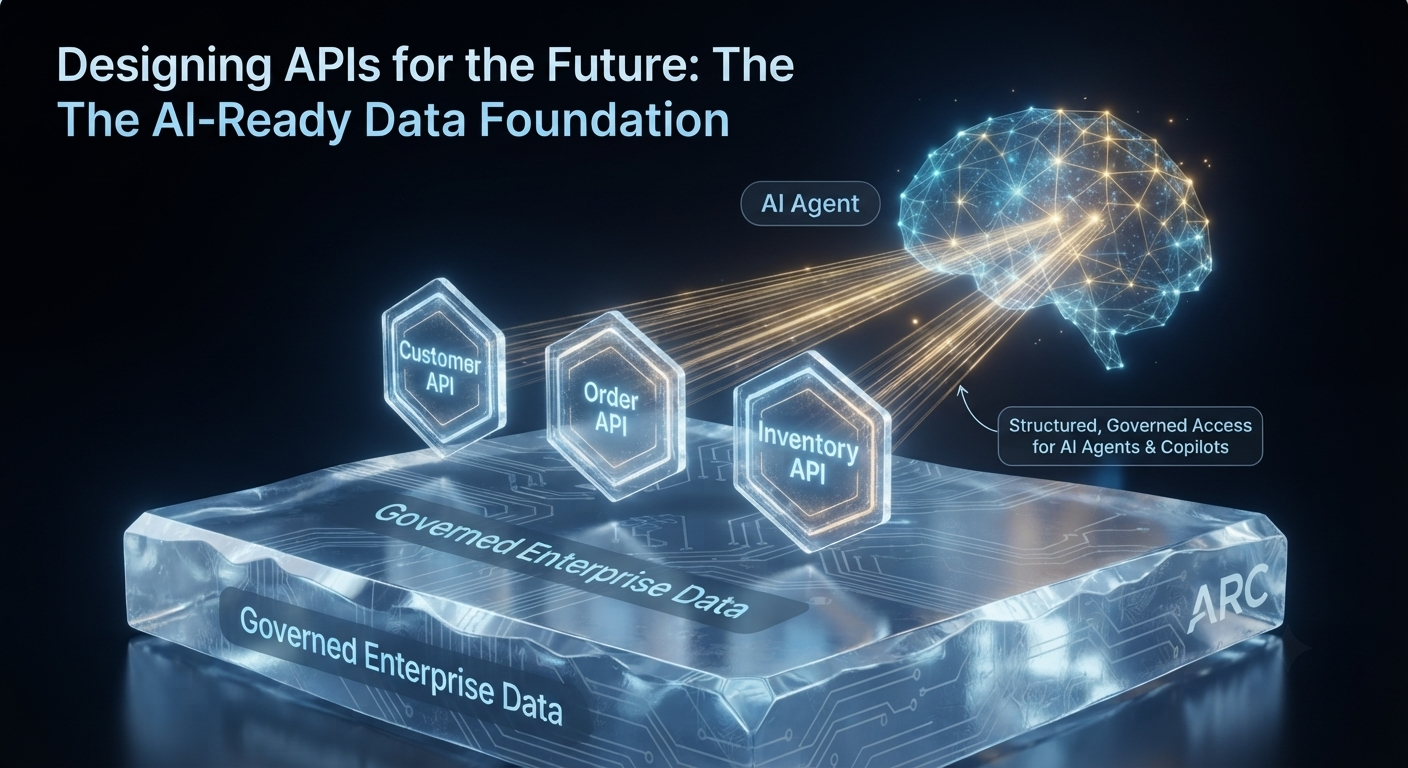
AI-Readiness and Agent-Ready APIs
AI tools need governed, structured access to enterprise data. API integration architecture provides the control plane for that access.
API Integration Architectures
Point-to-Point vs. Hub-and-Spoke vs. Event-Driven
| Pattern | How it works | Tradeoff |
|---|---|---|
| Point-to-point | Direct system-to-system links | Fast to start, difficult to scale and maintain |
| Hub-and-spoke | Central integration layer routes traffic | Better control and reuse, requires architecture discipline |
| Event-driven | Systems publish/subscribe to business events | Highly responsive, ideal for time-sensitive or high-volume flows |
Most organizations start with point-to-point integration and migrate toward hub-and-spoke or event-driven patterns as complexity grows.
Protocol and Format Landscape
Modern enterprise integration often combines:
- REST for common web API interactions.
- SOAP for older enterprise interfaces.
- GraphQL for precise data retrieval.
- Webhooks for push-based real-time events.
- EDI (X12/EDIFACT) for many partner and supply-chain exchanges.
Azure Integration Services Reference Architecture
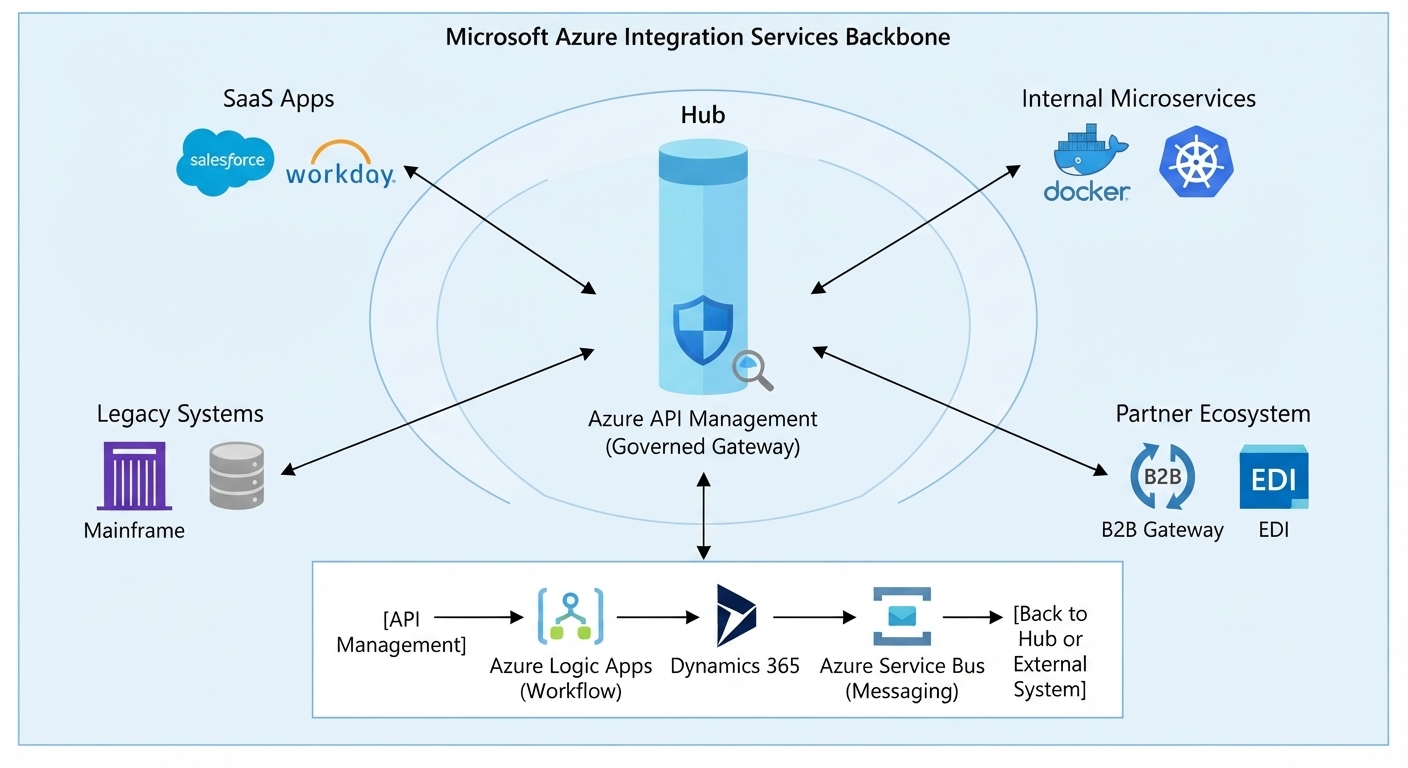
A common Microsoft-centered reference pattern:
Trading partners, SaaS apps, and internal systems
-> Azure API Management (governance and gateway)
-> Azure Logic Apps (workflow orchestration)
-> Azure Service Bus and Event Grid (messaging and events)
-> Azure Data Factory and data engineering services foundations
-> ERP, CRM, data warehouse, and BI endpoints
Azure consulting and Microsoft API Integration Services
Azure API Management
Provides the governed gateway for API security, throttling, policy enforcement, and versioning.
Azure Logic Apps
Orchestrates low-code workflows across Microsoft and non-Microsoft systems using pre-built connectors.
Azure Service Bus and Event Grid
Supports asynchronous messaging and event routing for resilient, decoupled integration flows.
Power Automate and Power Platform Connectors
Enables business teams to extend automation through governed low-code experiences layered on top of enterprise integration architecture.
Entra, Governance, and Monitoring
Identity, authorization, auditing, and policy controls should be standardized across all integration surfaces from day one.
Build vs. Buy vs. iPaaS
| Approach | Pros | Cons | Best for |
|---|---|---|---|
| Build in-house | Full control, tailored behavior | Requires specialist capacity and higher maintenance burden | Mature engineering teams with unique constraints |
| iPaaS | Fast setup and many connectors | Ongoing platform cost and potential lock-in | Standardized integration portfolios |
| Managed integration services | Architecture expertise, delivery acceleration, operational support | Requires partner selection and governance model | Multi-system enterprise integration programs |
How to Choose an API Integration Services Partner
Technical Breadth
Look for delivery capability across REST, SOAP, GraphQL, webhooks, and EDI.
Microsoft Expertise
For Microsoft-centered environments, choose teams with practical Azure API Management, Logic Apps, and Service Bus experience.
Security and Governance
Review how the partner standardizes authentication, rate limiting, API policy, and data governance and data security controls.
Monitoring and Support
Validate post-launch operations: alerting, incident response, ownership, and version-change procedures.
Vendor-Flexible Delivery
Microsoft-native architecture should still connect non-Microsoft systems cleanly.
ARC Delivery Process
- Discovery: system mapping, pain-point analysis, and objective alignment.
- Architecture: integration pattern design and platform decisions.
- AI-accelerated build: implementation with testing and hardening.
- Launch and support: monitored operations with continuous optimization.
Common Challenges and How to Avoid Them
| Challenge | Why it happens | How to avoid it |
|---|---|---|
| Fragile point-to-point sprawl | Integrations are added ad hoc | Establish a reusable hub pattern and governance model |
| No ownership after go-live | Project teams disband | Define operational ownership and SLAs before launch |
| Security inconsistency | Authentication varies by integration | Standardize token strategy, policy, and access controls |
| Schema-change breakage | Upstream systems evolve without process | Implement versioning and controlled change management |
| One-time project mindset | Teams underfund run-state operations | Budget observability, maintenance, and support from the outset |
Best Practices
- Decide architecture first, tools second.
- Standardize authentication and governance.
- Build observability from day one.
- Plan for schema and API version changes.
- Align integration design with analytics and AI goals.
- Keep business ownership and technical ownership explicit.
- Use Microsoft-native building blocks when they reduce complexity and risk.
Future Trends
- AI workloads are raising expectations for integration speed, quality, and governance.
- API-first operating models continue to expand across enterprise software ecosystems.
- Agent-ready API design is becoming a practical requirement, not a future concept.
- Governance and integration are converging into a single operational discipline.
What Should Be Included in an API Integration Assessment?
A thorough assessment should evaluate:
- Current system landscape and existing integration points.
- Data flow requirements and latency expectations.
- Real-time versus batch processing needs.
- Authentication, governance, and risk controls.
- Existing operational pain points and workarounds.
- Recommended architecture and realistic delivery roadmap.
- Expected effort, timeline, and cost range by phase.
Key Takeaways
- API integration services connect systems into reliable business workflows.
- Architecture quality determines long-term maintainability and scalability.
- Azure integration services provide a strong Microsoft-native foundation.
- Security, governance, and observability are core requirements, not extras.
- AI-readiness depends on governed, stable API access to enterprise data.
Ready to Scope Your Integration Program?
If your teams are still reconciling spreadsheet exports and manual handoffs, this is the right time to standardize your integration architecture.
Talk to ARC about an integration service roadmap tailored to your systems and business priorities.
Publishing Verification Notes
- Re-validate external statistics before publication because source reports are updated frequently.
- Keep a clear distinction between Microsoft platform-level metrics and ARC implementation outcomes.
- Keep this post cross-linked with the system integration and data engineering cluster pages.
- Confirm destination URLs if any service routes change before publish.
- Ensure architecture visuals remain current as Azure service naming evolves.
Frequently Asked Questions
What are API integration services?
API integration services connect disparate software systems using APIs to synchronize data, automate workflows, and enable applications to work together as a unified system, rather than requiring manual data transfer between them.
What is the difference between API integration and API management?
API integration is about connecting specific systems to transfer data and automate workflows. API management is the broader discipline of governing, securing, and monitoring APIs at scale, typically through a centralized gateway.
When should we use API integration services instead of iPaaS?
API integration services via a consulting partner typically fit complex, multi-system enterprise integrations requiring custom architecture and ongoing support, while iPaaS platforms work well for organizations needing multiple standard integrations quickly with pre-built connectors.
What is Azure API Management used for?
Azure API Management provides the governance and security layer for publishing, securing, monitoring, and versioning APIs, controlling who can access which APIs and under what conditions.
How do Azure Logic Apps fit into API integration?
Azure Logic Apps provide low-code workflow orchestration for connecting applications and automating multi-step processes, using a large library of pre-built connectors spanning Microsoft and third-party systems.
REST vs SOAP vs GraphQL, which should we use?
REST is the most common approach for modern web APIs, SOAP remains common in older enterprise systems with strict messaging standards, and GraphQL allows clients to request exactly the data they need. Most enterprise environments use a mix depending on which systems are involved.
What role do webhooks play in integration?
Webhooks allow systems to push real-time notifications when specific events occur, eliminating the need for constant polling and enabling faster, more responsive data synchronization.
How do API integration services handle authentication, rate limits, and retries?
Well-designed integration services standardize authentication, commonly OAuth 2.0, API keys, or JWT, implement rate limiting to protect source systems, and build in retry logic to handle temporary failures gracefully.
How can we integrate ERP, CRM, WMS, and partner APIs?
This typically requires a combination of API-based connections, EDI for trading partner exchanges, and a central orchestration layer, such as Azure Logic Apps, to manage data flow and transformation between different system types.
Can ARC integrate non-Microsoft systems?
Yes. While ARC's architecture approach is Microsoft-native, delivery is vendor-flexible, and most enterprise environments include SaaS applications and legacy systems outside the Microsoft ecosystem that still need to be part of the integration architecture.
What should be included in an API integration assessment?
A thorough assessment covers the current system landscape, data flow and real-time requirements, authentication and security needs, existing pain points, recommended architecture, and a realistic timeline and cost range.
What are the biggest security risks in API integration?
Common risks include inconsistent authentication across integrations, inadequate rate limiting, insufficient monitoring for anomalous access patterns, and poor governance over which systems and users can access which data.
How do we monitor and support integrations after launch?
This requires clear ownership, active monitoring and alerting for failures or anomalies, a defined process for handling schema or API version changes, and an ongoing support model, all established before go-live.
What is the business value of API-first integration?
API-first organizations report meaningfully higher rates of generating direct revenue from their APIs, alongside faster development cycles, better scalability, and stronger foundations for AI and digital transformation initiatives.
How do API integrations support AI agents and digital transformation?
AI agents and Copilot-style tools require governed, well-structured API access to enterprise data to function reliably. Organizations that design their API layer with this in mind are better positioned to adopt AI capabilities as they mature.

Al Rafay Consulting
ARC Team
AI-powered Microsoft Solutions Partner delivering enterprise solutions on Azure, SharePoint, and Microsoft 365.
LinkedIn Profile